
She considers himself a “warrior artist”, whose belief is that art must be a deviation from normality, a mental risk, because only by confronting the unexpected and fear can we evolve. She is considered a pioneer of performance art, a cross-border artist who navigates the boundaries between body, mind, and audience. Featuring more than 100 works and 4 live performances daily, including iconic works such as Imponderabilia, Luminosity, Nude with Skeleton, and Art Must Be Beautiful – Artist Must Be Beautiful, the exhibition Marina Abramović is the eponym and wide retrospective on Marina Abramović’s artistic career.

The first major retrospective of Abramović in Austria, organised and hosted by Albertina Modern in collaboration with the Royal Academy of Arts in London, the Stedelijk Museum in Amsterdam, and the Kunsthaus in Zurich. Curated by Bettina M. Busse, the exhibition is on display until March 1, 2026. And with this retrospective, the 78-year-old artist takes stock of her radical life’s work for the first time in Austria and demonstrates that art is always an existential experience.
The Viennese exhibition presents the stages of her artistic career in a multimedia format, including videos, photographs, installations, sculptures, and drawings, and unfolds from the beginning of Abramovic’s artistic career, when, in her native Belgrade, in the early 1970s, she began to attract the attention of the public and critics. Setting up a performance artist’s retrospective is not easy in terms of “dialogue” between the visitors and the works. Each room has been set up with a specific theme, such as “participation”, “body limits”, “energy from nature”, and “enlightenment”, and there is a focus on reenactments of historical performances and thematically designed rooms.

The immediate impact of her physical presence cannot, of course, be reproduced – but that is not the goal. Rather, the retrospective offers a comprehensive overview of the breadth of her oeuvre: from the Golden Lion-awarded performance at the Venice Biennale to the collaborative works with her long-time partner Ulay. Throughout the exhibition, daily reenactments of historical performances are a central feature, allowing visitors to witness her iconic work firsthand, although the most brutal actions are unlikely to be visible.
“The immediate impact of her physical presence cannot, of course, be reproduced – but that is not the goal. Rather, the retrospective offers a comprehensive overview of the breadth of her oeuvre”.
Abramović, Performance And Body
Undoubtedly, performance is Abramović’s label; in an interview with Italian newspaper Corriere della Sera, she stated that performance was the most suitable medium for expressing her personality, because it is a direct art form that allowed her to explore fear, pain, and death, and to present these emotions to the audience as if in front of a mirror. By doing so, she believed that art uplifted the spirit. For her, a daughter of communist partisans in Yugoslavia who held high governmental positions in Tito’s dictatorial regime, making art was not easy; too many artworks are, in her opinion, useless and lacking in intensity, and therefore she has no regrets for the suffering she subjected herself to.
At the same time, for her, art won’t change the world, but it can offer the opportunity to see things differently and make people reflect. For over four decades, Abramović has vigorously devoted her life to executing commanding performances; each one manifested with a bespoke depth of tone and feeling, addressing issues that are simultaneously personal and universal. By so doing, she has redefined art and pushed it to the limits of the bearable. Since the early 1970s, she has used her own body as a medium, a projection surface, a touchstone for endurance, pain, and consciousness.
“For her, art won’t change the world, but it can offer the opportunity to see things differently and make people reflect”.
Abramović has always used her body as her primary instrument of expression and the undisputed protagonist of her performances in which, since the beginning of the 1970s, she has experimented and challenged the limits of psycho-physical resistance with actions repeated until exhaustion.
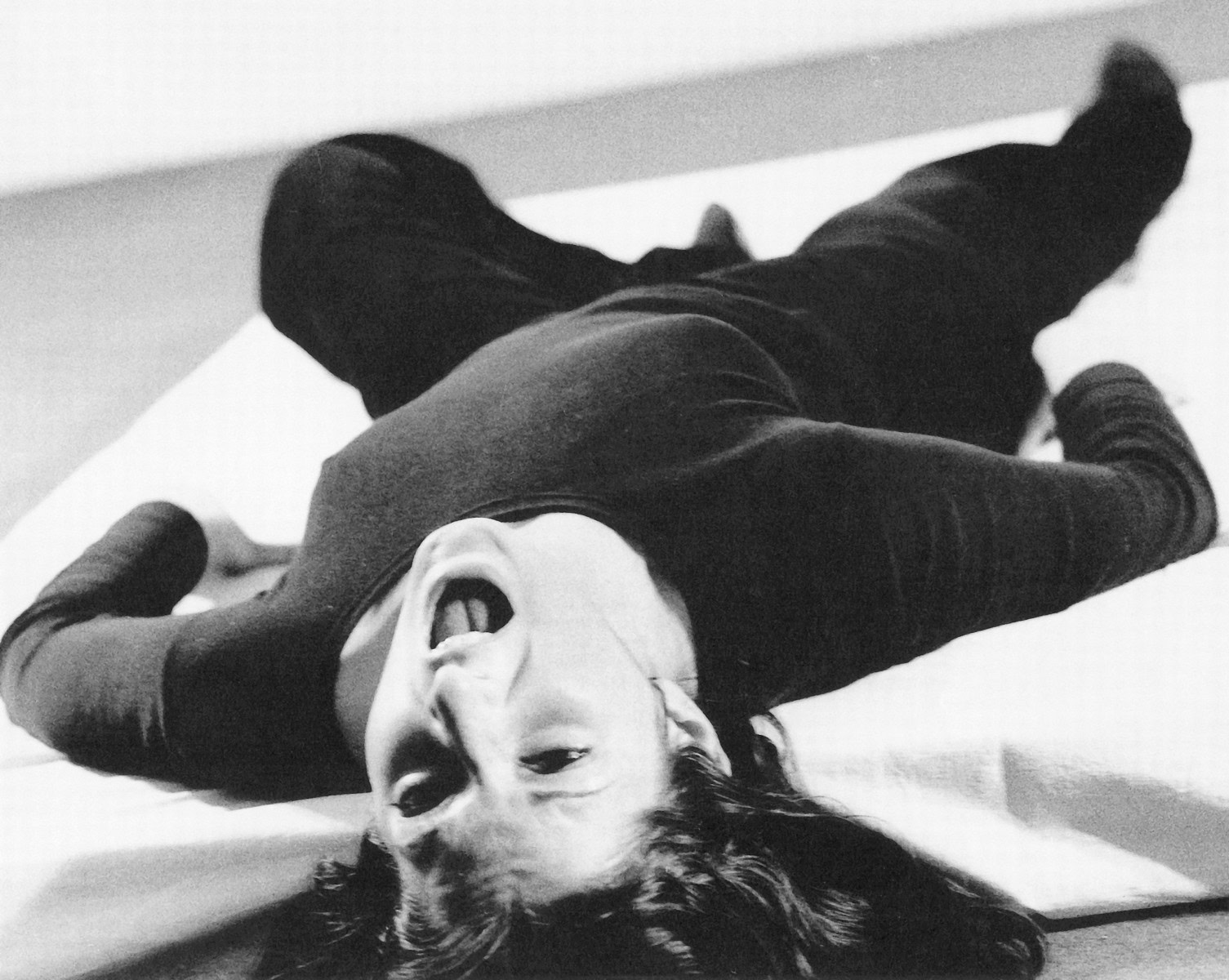
She subjected her body and mind to extreme physical and psychological tests, often coming close to death. Her self-challenge led her to explore the limits of human endurance, to the point of total exhaustion and subsequent fainting, often causing intolerable discomfort among the audience. When she passed out while lying in the midst of a burning star during one of her performances, she did not let that stop her. Instead, she used what had happened as inspiration for a series of performance pieces during which she actively strove to become unconscious. These early experiments marked the beginning of a career that would lead her to take ever-greater risks when it came to pushing the boundaries between performance, life, and death. For her, art is not a completed act, but a process: “When death knocks at my door, I want to enter that final experience consciously and without fear.”
Abramović’s Early Works
An interesting point of the exhibition is the focus on early works, among them The Airport (1972), where she used an airport PA system to announce imaginary flights to worldwide destinations. This performance, created while she was a student in Belgrade, was a reaction to the strict travel limitations of the Tito era and served as an early example of her work as an immaterial experience involving audience interaction. It is cited as a significant piece that foreshadowed her future artistic themes of immateriality and audience participation. Moreover, Abramović’s early performance series Rhythm (1973-1974) combines concept with physicality, endurance with empathy, complicity with loss of control, and passivity with danger. The artist placed a series of objects -including a feather, several knives, and a loaded pistol – on a table, allowing the audience to do whatever they wanted with the motionless artist’s body. Abramović assumed full responsibility for everything that happened. Already it was about time, silence, energy, and the heightened awareness evoked by long-duration performances – themes that run through Abramović’s entire oeuvre. To her, the body was both subject and medium. By exposing herself to pain, total exhaustion, and danger, she kept pushing her physical and psychological limits, always in quest of emotional and spiritual transformation.
And in Lips of Thomas (1975), she ate a kilo of honey and drank a litre of red wine before carving a five-pointed star into her stomach with a razor blade, lying on a large block of ice, and simultaneously directing a heat lamp at the wound. The radical nature of such actions can naturally only be guessed at in an exhibition featuring historical video footage. But the staging of the exhibits impressively illustrates Abramović’s uncompromising approach to her work. Even without a live experience, this is fundamentally not for the faint of heart. The artist regularly goes to extremes to continually explore the limits of the body. Self-harm, nudity, and screaming are not to be shied away from in this exhibition either.

Marina And Ulay
In the second half of the 20th century, Marina Abramović and Ulay (Frank Uwe Laysiepen) were the artists who most impressed, intrigued, and provoked the entire world. The two met at the Appel Gallery in Amsterdam in 1976, when their careers were already well underway. From the very beginning, they decided to take the all-encompassing bond that held them together even further to explore the themes of social relationships and love, through unforgettable performances centred on the body.
Marina Abramović and Ulay have achieved international fame, as well as critical and public acclaim, since the 1970s, thanks to often disconcerting performances, all centred on the body, used as material, as an artistic medium to conduct an in-depth investigation of social and relational dynamics. “Together”, wrote art critic Martina Corgnati, “the two stage many extreme positions and systematically explore several key relationships: man-woman, male-female, body-body, person-person, in countless variations, including possible symbiosis, osmosis, complicity, antagonism, distance, intrusion, violence, tenderness, passion, and complementarity. They often implicitly ‘challenge’ each other, using each other as a platform for open confrontation and conflict, a testing ground”.
They remained together in both life and art for 12 years, until 1988, when they announced their separation to the world with a famous performance on the Great Wall of China. When the two resumed working alone, Ulay returned to devote himself exclusively to photography, while Abramović continued with performance art, achieving great popularity.

Marina Abramović
In the 1970s, she ideated a way of communicating to connect with the audience through an exchange of energy, which she assimilated and reflected back, creating a veritable magnetic field. Only through this energy was she able to overcome her physical and psychological limitations. But this was not improvisation, but rather a lengthy process of preparation, exploring diverse cultures that have much to say on the subject, drawing on a long tradition of meditation techniques that bring the body to a state of confinement, a limit, enabling a mental leap to reach different dimensions of existence and eliminate fear, pain, and the limitations of the body. In this exhibition, visitors are invited to participate in some way: in the final room, they are invited to sit at a table and count grains of rice – a meditative practice Abramović developed in preparation for her mentally and physically demanding performances.
But the problem, if you can say so, is that Abramović built a career just repeating ideas developed in the 70s with very little change and a new way to approach the public and the idea of art. Just like Warhol, who created the repetition of the artwork, Abramović created the repetition of the performance, and she has now very little to say about our contemporary topic, differently from what an artist should do during their career.
“But the problem, if you can say so, is that Abramović built a career just repeating ideas developed in the 70s”.
Still, the “Abramović Method” is clearly proving popular: the table – the final stop is almost always occupied, and people are counting with concentrating, as if seeking inner balance, a way to calm down after the tension.

Marina Abramović
October 10, 2025 – March 1, 2026
Albertina Modern, Vienna