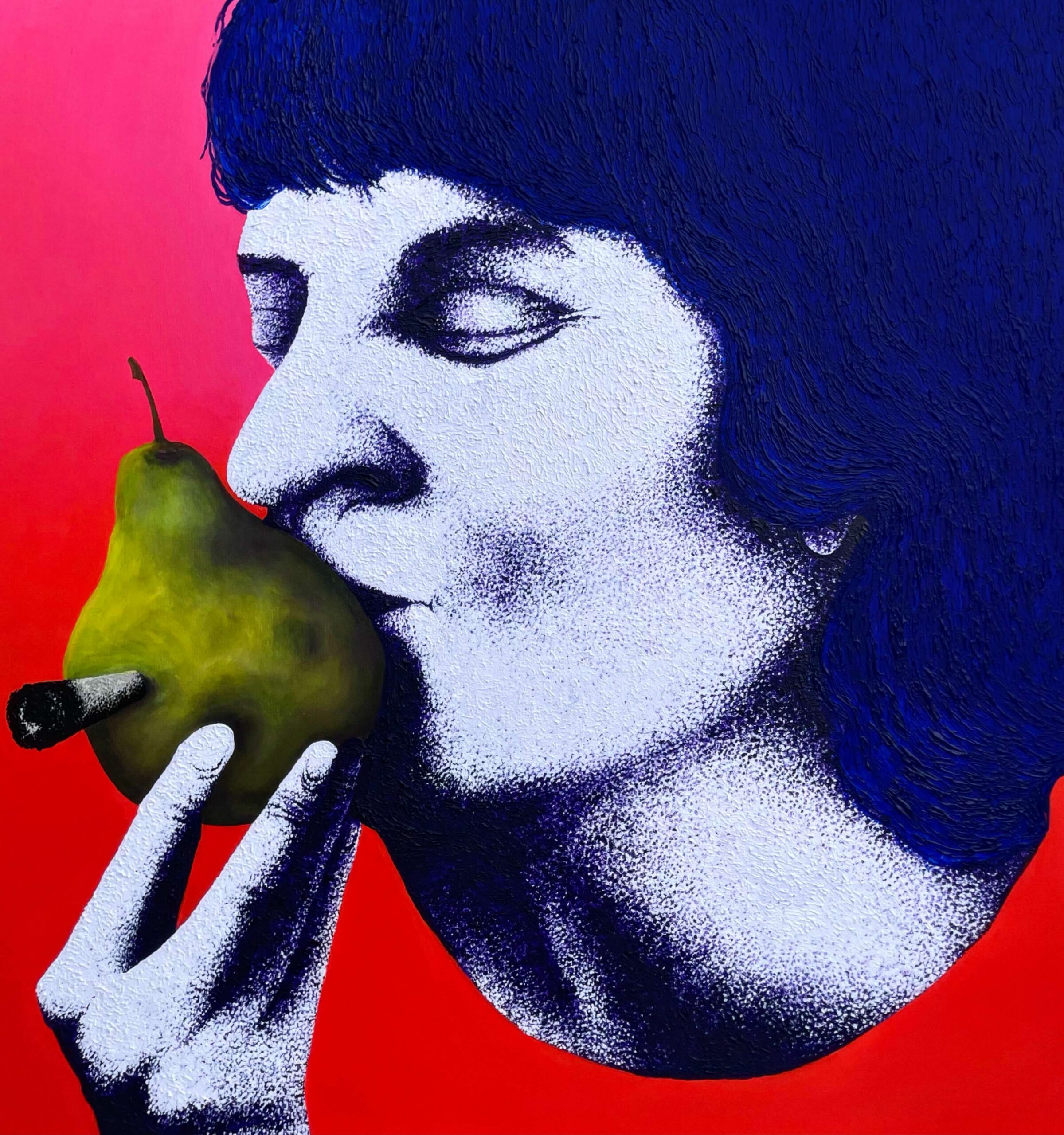
Creating across painting, objects, and performance art, Ewa Babiarz delves into themes of auto-mythology and experiences of love, trauma, and corporeality. Her work is unabashedly feminist, witty, and bold, addressing Freudian tropes and confronting contemporary trends in gender roles. Her series of paintings, Rozgrzana Skrzyneczka (A Little Heated Box), has been recently awarded both the main prize and a special distinction by Contemporary Lynx in the New Image / New Perspective competition, organized by the Magdalena Abakanowicz University of Fine Arts in Poznań.

The awarded paintings focus on female subjects, exploring the formation of female sexuality and the internalization of patriarchal culture. What makes them visually distinctive is the inclusion of a bold element at the forefront — from a worm woven through a woman’s ear to a pose in which the subject’s fist holds firmly to her palm. These characteristic elements align with Babiarz’s wider practice, through which she navigates a journey of healing after sexual violence and brings into question the Freudian “Madonna-Whore” archetype.
Following her success in the competition, we spoke with Ewa Babiarz about the experiences that inform her practice, the ideas behind Rozgrzana Skrzyneczka, misleading perceptions of feminism perpetuated by the media, and her plans for the future after graduation.
Sophia Kalinowska-Werter: You describe your artistic practice as involving auto-mythological narratives in relation to corporeality, sexuality, and sexual violence. What does “auto-mythology” mean to you, and how does that translate to your work?
Ewa Babiarz: For me, auto-mythology is sort of a fan fiction about my life, experiences, and other stories along the way. First and foremost, I use this phrase to avoid exposing any third parties to unnecessary complications in their lives. In my work, I usually take autobiographical experiences as my starting point, but I do occasionally touch on themes relating to third parties. I attempt to properly recreate them in a way that doesn’t change their sense and essence, while considering and respecting others and their privacy boundaries.

SKW: Your graduation project, Rozgrzana Skrzyneczka (A Little Heated Box), explores how female sexuality is shaped and what oppresses it. In your opinion, what is the most harmful current narrative being pushed against women, and how can artists or activists attempt to combat it?
EB: It’s hard for me to say with absolute certainty which of the currently widespread narratives is objectively worse. I think there are many related social issues that still need to be addressed. Generally speaking, what I fear most is the idea that feminism is personified by a “crazy woman” who is ignorant about the world but, quite mistakenly, wants to take complete control of it. I fear this circumstance where women don’t want to associate with feminism because of the negative connotations that propaganda in the media perpetuates.
Recently, I’ve participated in a few talks in which women discussed topics related to organizing a life full of independence and agency. However, even though their attitudes fit perfectly with what I believe to be the foundation of feminism, they emphasized with conviction that they are not, and never will be, feminists. It really stuck with me, and I can’t stop thinking about it.
Generally speaking, what I fear most is the idea that feminism is personified by a “crazy woman” who is ignorant about the world but, quite mistakenly, wants to take complete control of it. I fear this circumstance where women don’t want to associate with feminism because of the negative connotations that propaganda in the media perpetuates.
I’m also fearful of the increasingly popularised trad-wife trend that’s all over social media and how it will affect people’s perceptions of gender roles. I do believe, of course, that everyone has the right to live the life they want. It’s just about the freedom of choice and accessibility to a full plethora of possibilities.
I don’t know how artistic people can stand up for themselves other than through open dialogue. I, too, believe that people are most afraid of what is unfamiliar to them and may blow things out of proportion in their own minds. That is why I, as an artistic person, try to, above all, clearly state my views on this matter. I hope that in this way I can help humanize the “crazy feminist” stereotype and transform it into the face of every woman who simply wants to feel empowered and safe in life and who expects reliable healthcare.

SKW: The name of your project, Rozgrzana Skrzyneczka (A Little Heated Box), intrigues me particularly. What was your thought process when brainstorming this title?
EB: The title of my work is taken from Melissa Febos’s book Girlhood, which tells the author’s autobiographical story of her experiences of sexual violence. It appears in one of the first chapters in the context of adolescence. It was the first book I picked up specifically for my thesis, and as soon as I read that phrase, I knew it would be the title of the whole series. The term really resonates with me. I’m including the whole passage that inspired me because I think it’s worth noting.
“The oven at eye level, your forearms covered in burn marks. A memento of every time you reached above your head. Are you still a child, or already Einstein’s definition of madness? You like to bear the marks (…) Oh, if only you could mark the floor with the heat that seethes within you. You hold it within you, you little heated box, a tiny steaming teapot. You fill yourself up without spilling a drop. You won’t let the marks fade.”

SKW: I noticed that you have a recurring motif of worms throughout your other works. What’s the significance of this?
EB: Yes, worms are definitely a subject very close to my heart. In my practice, I focus primarily on themes related to life after experiencing sexual violence — something which, from the very beginning, has somehow naturally been linked in my mind to worms, which often evoke extreme emotions.
Particularly close to my heart is the image of the earthworm. For me, it serves as an allegory of inner unease and alienation within the body — something that unexpectedly burrows deep into the tissue of the internal organs, writhing restlessly with every movement, however slight. Something that you can’t get rid of; something that you have to live with for the rest of your life.
In my practice, I focus primarily on themes related to life after experiencing sexual violence — something which, from the very beginning, has somehow naturally been linked in my mind to worms, which often evoke extreme emotions.
I used to be fascinated by the Wingless Blacksmiths, commonly known as “tram drivers.” They are those red worms joined at the rear that most Polish children remember from their childhood. It is worth noting here, although it may be obvious, that these chains of worms do indeed have sexual connotations. In my memories, I also view them with no small amount of revulsion and fear, although in reality, they are completely harmless, and their vivid color is meant to deter potential predators.

SKW: As you approach the end of your studies, have you thought about what’s next for you?
EB: On June 15th, I defended my Master’s degree project at the Academy of Fine Arts in Katowice, and to be honest, I’m feeling a bit lost. I mean, I’m really delighted with all the successes I’ve had in the New Image / New Perspective competition, including this honor, because they’ve given me the feeling that the hard work I’ve put into my painting over the last five years might actually take me somewhere. It has made me feel that perhaps one day I’ll really be able to treat the visual arts as my main focus in life — or at least as something that isn’t second to my day job, family, and household chores, which has always been my greatest dream.
I’m afraid that I’m rather addicted to creative work, so focusing on that would be the ideal scenario.
I’m afraid that I’m rather addicted to creative work, so focusing on that would be the ideal scenario. At the moment, I’m looking for a studio. I’ve already got my eye on one, and I’m waiting to see how things pan out. I’ve also received a few interesting exhibition offers for next year, which I won’t reveal just yet as I don’t want to jinx it. Last year, I visited a friend in Iceland, and since then, I’ve been thinking about going there for an artist’s residency, but I’ve done absolutely nothing about it apart from some very preliminary research, so that’s definitely something for later. I’m also considering studying sociology to give my artistic practice a slightly more research-oriented slant, focusing on social issues that have long fascinated me.
Generally speaking, I suppose I have plenty of ideas, but for now, only the studio is at the implementation stage. I definitely need a bit of a rest too, ideally with a book on some wild Baltic beach.