



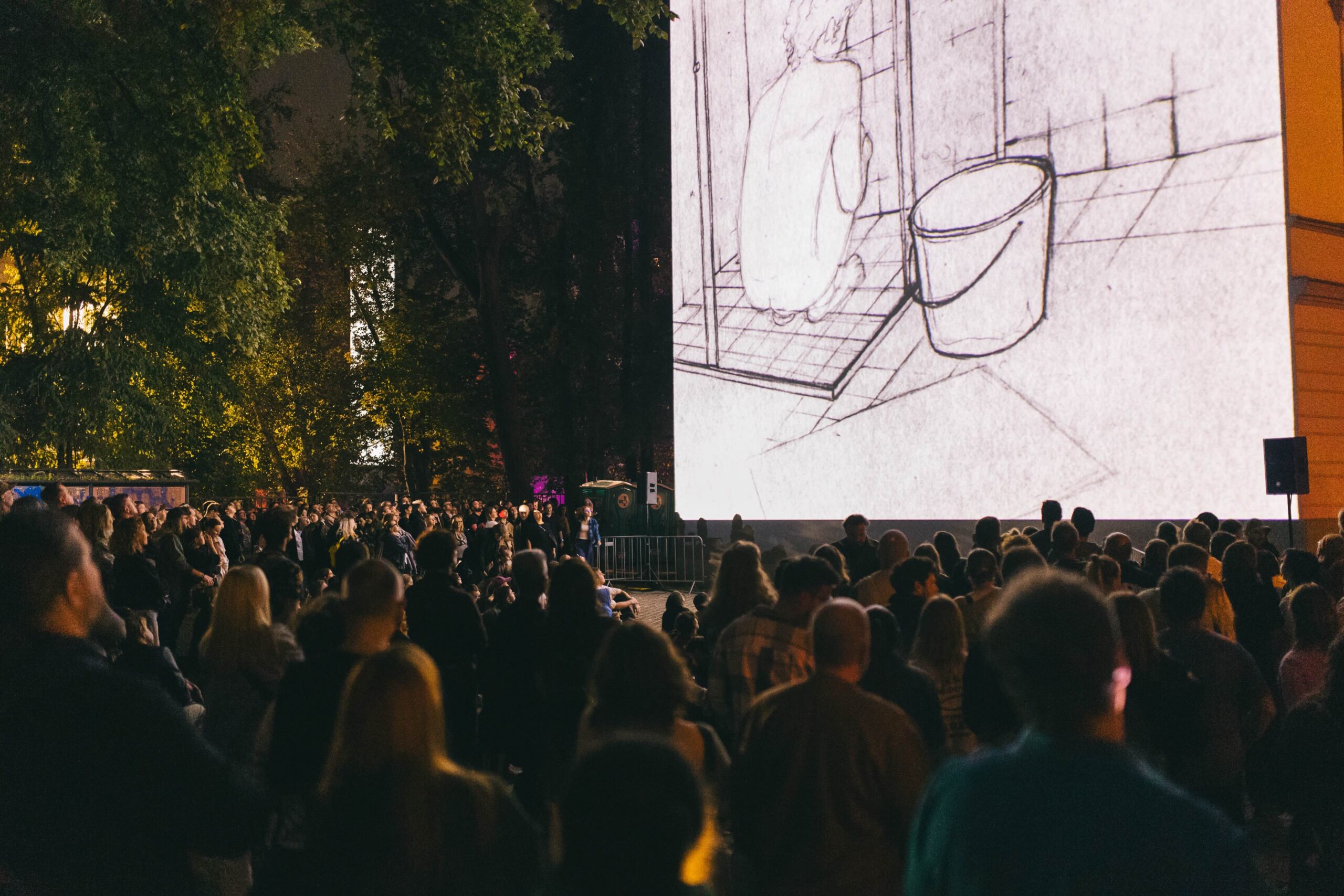
A woman tries to get through her daily routine, but she cannot leave the bathroom — this is the basic premise of Luísa Bacelar’s unsettling hand-drawn animated short Wisdom Tooth, in which cleaning becomes an obsessive ritual and a mirror for the protagonist’s anxious thoughts. Accompanied by unnerving, repetitive sounds that heighten the uneasy atmosphere, what begins as an attempt to maintain control gradually turns into body horror.

Luísa Bacelar is an artist based in Brazil, working with a variety of analogue and digital media, including both moving and still formats. She began her artistic journey with drawing and later expanded her practice into digital design, now often intertwining the two. Recently awarded the Contemporary Lynx Award at the Kinomural Festival in Wrocław, Wisdom Tooth was developed as part of her master’s thesis at HFBK Hamburg. To mark the success, we spoke to Bacelar about her inspirations, the meaning of physicality in a process of creating a hand-drawn animation, and the relationship between anxiety and repetitive behaviour.

Sophia Kalinowska-Werter: Would you say there was a particular, formative moment in your life that inspired your artistic direction?
Luísa Bacelar: I think more than one moment influenced my artistic direction. While studying Graphic Design, I was especially interested in a class on animation and motion design, which first made me start animating and later led me to make my first short film, Medo.
Another important point was getting into HFBK Hamburg. It was the first time I really started thinking about my work from an artistic, more conceptual perspective.
Later, I took part in the Animation Workshop in Lanckorona, Poland, with Professor Jerzy Kucia. This gave me a new perspective on the project I was working on at the time and, especially, the space to experiment with analogue animation. I’m also a big admirer of Polish animation, so that experience was particularly meaningful to me.

SKW: What made you decide to move to Hamburg to study at HFBK? Was it a long-term dream of yours, or did the decision evolve?
LB: This decision evolved over time; I cannot point out a specific moment that led me to choose Hamburg. When I started my animation practice, I was really interested in German artists like Hans Richter, Walter Ruttmann and Oskar Fischinger. I also saw Germany as a country with many artistic and funding opportunities, and I already knew a bit of German, so everything was pointing in that direction. I was initially interested in studying illustration or animation, but ultimately I was drawn to the HFBK programme. It offered a much freer, more experimental environment, and it changed the course of my art practice.

SKW: Your body of work is composed of a spectrum of artistic mediums, integrating traditional and digital media. Do you have a particular soft spot for one medium, or are these forms inseparable for you?
LB: I don’t see myself giving up either practice; I consider them complementary and essential to my work. That said, I definitely have a soft spot for traditional media! I originally drew by hand, but later moved into design and became heavily involved with digital media; I only gravitated back towards analogue methods once I began my artistic practice.
I don’t see myself giving up either practice; I consider them complementary and essential to my work.
I haven’t abandoned digital work; I still spend a lot of time on the computer, especially since the post-production phase would be impractical without digital tools when working with film. But I admire the materiality of things; there is something magical in what you can touch. I also feel much freer to make mistakes in traditional media, experiment and incorporate accidents into the final work; little scratches on the paper, the textures, things that are sometimes avoided, can have an interesting aesthetic appeal. I feel the work comes out much more fluid on paper; the analogue medium has limitations that, I think, force me to come up with more creative ideas. But I am also excited about the possibilities of the digital and maybe even incorporating a more digital aesthetic into my artistic work. I have also worked briefly with projection mapping and am interested in going back to it.
I feel the work comes out much more fluid on paper; the analogue medium has limitations that, I think, force me to come up with more creative ideas.

SKW: What does your creative process look like when it comes to the sound you use in your video projects? Does the concept for the audio come to you during the project’s initial inception, or do you experiment while the project is in progress?
LB: It depends on the project. On my last film, the one exhibited at Kinomural, Wisdom Tooth, I imagined how I wanted it to sound while I was drawing it, but I only commissioned a sound artist at the end, when the film was almost finished. I am also interested in working with noise music and noise artists. I used to have friends who made noise music, and I collaborated with them on my first animation projects. I also like experimenting with recording street noise. In another film, A que ponto chegamos?, I used only sounds I recorded while riding on old buses in Brazil. But sound is something I am still interested in exploring more; ideally, I like to start with sound to guide the rhythm of the images.

SKW: Your awarded short film Wisdom Tooth presents a surreal perspective on the monotony of everyday life, as the protagonist becomes increasingly trapped in repetitive rituals. At the same time, everyday acts of hygiene gradually take on an unsettling, almost body-horror quality. What interested you in bringing these two aspects together? Do you see hygiene as connected to anxiety, control and the need to make an uncertain environment feel manageable?
LB: I feel like hygiene and cleaning have a lot in common with anxious thoughts; they both work in a cyclical way. If you shower today and leave everything clean, the dirt will eventually come back, and you will have to clean it again. And the anxious mind is the same; anxious thoughts always recur in a repetitive pattern. And if you cannot control the thoughts, you can at least control the body and the cleaning — or at least distract yourself with it. But that is also an illusion. In the end, there is no way to control it, and I think that’s why it culminates with the loss of the tooth, which for me is the ultimate body horror: one cannot control the body in the same way one cannot control the thoughts.
I feel like hygiene and cleaning have a lot in common with anxious thoughts; they both work in a cyclical way.

SKW: You chose to make the film entirely by hand. What does the physicality of that process add to a story so concerned with the body and repeated gestures?
LB: Animating by hand is a repetitive bodily process; for me, it’s as much an obsessive ritual as cleaning the bathroom. Besides that, I feel that a physical medium usually adds a lot of unpredictability — things I cannot fully control, that become part of the work. I often use the sketches themselves as the final drawings because I want to keep the imperfections. I want the marks on the papers, the slightly off drawings. For me, they are like traces of a body’s presence, and that can add another layer to the narrative.

SKW: What’s next for you? Do you have something on the horizon you’re excited about, or do you plan to work more spontaneously?
LB: I’m currently working on another film project, but it is still in the script phase. After six years in Hamburg, I recently decided to come back to Brazil. Right now, I am interested in working with different themes. I want to explore stories connected to the territory I come from, as well as tell other people’s stories and make more collaborative projects.
This is still in an early phase, so I cannot elaborate much more on it yet, but I hope to have something new to show soon.
I often use the sketches themselves as the final drawings because I want to keep the imperfections. I want the marks on the papers, the slightly off drawings. For me, they are like traces of a body’s presence, and that can add another layer to the narrative.