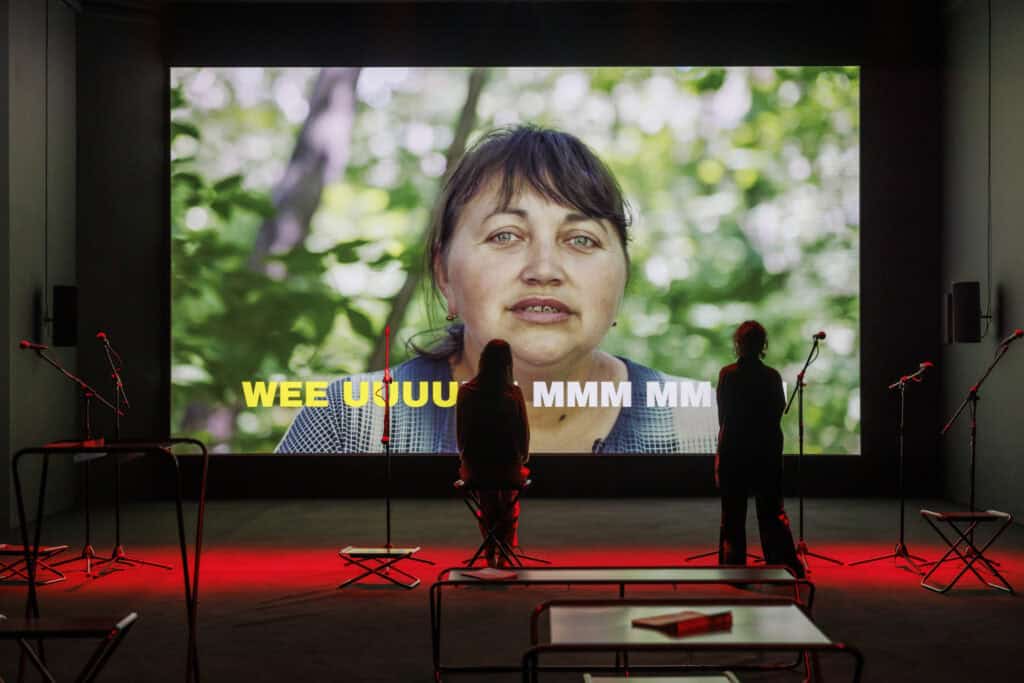
“I thought we had lost our minds in the darkness. Only now do I realise that without darkness, we would not see anything,” wrote British artist Lulu MacDonald in her diary Seeing in the Dark. This sentence, describing the experience of bioluminescence at night, is the basis for the logic of her exhibition Where the Light Won’t Reach, presented at the SIC! BWA Wrocław gallery until May 31.

Rooted in the history of rhubarb cultivation in Yorkshire’s Rhubarb Triangle in England, the exhibition examines systems of accelerated growth, control, and adaptation. Moving between installations, sound, and sculpture, MacDonald traces the often invisible structures that shape both natural and social life — from industrial labour and ecological exploitation, to the fragile conditions that sustain growth.
Moving between installations, sound, and sculpture, MacDonald traces the often invisible structures that shape both natural and social life — from industrial labour and ecological exploitation, to the fragile conditions that sustain growth.
Between growth and pressure
Locked in sheds and cut off from light, rhubarb grows using the energy previously stored in its roots. In order to use the plant for mass production, its growth process has been accelerated. It is not neutral to nature. “Forcing,” which is the name of this practice, describes not only the technique, but also the relationship: between growth and pressure, between time and its acceleration, between life and its efficiency.

The conditions of this forced development are also significant. Forcing detaches rhubarb from its natural cycle and subordinates it to the production process. The time is shortened, and cultivation is accelerated — not in response to the plant’s needs, but in accordance with the logic of exploitation.
The controlled humidity and temperature conditions mislead the plant. It is kept under the constant impression that it is summer. It continues to grow, seeking light that is not there, responding to man-made signals. The relationship between nature and its environment is altered: light is no longer a source of life, but its regulator.
In the work Forcing Rhubarb, sound develops this narrative even further. It creates an unstable environment where growth does not lead to balance but is sustained through a system of conditions. In this sense, the work shifts the focus from growth itself to the mechanisms that force it: to the system of stimuli that sustains life yet simultaneously detaches it from its natural rhythm.

The limits of visibility
“Rhubarb is grown in boarded-up sheds, and yet it still reaches for the sun,” says Lulu MacDonald. This movement towards something that is not there is both simple and elusive. The plant does not see the light, yet it moves towards it. Growth happens without witnesses, without confirmation — beyond the control of sight, though not beyond the control of the conditions designed for it.
This statement also reveals the tension between the ability to persist and the costs it entails. The plant grows despite the constraints, but under conditions that lead to a faster depletion of resources. Darkness is thus not just a backdrop. It co-creates the course of this process, simultaneously accelerating and constraining it.

Darkness also possesses its own structure: it gathers sounds, disperses shapes, and stops time differently than light does. Within darkness, things do not form stable shapes, but draw near and recede, as if eluding complete grasp. What emerges depends on the situation, on motion, on the relationship.
Lulu MacDonald’s project unfolds within such parameters. It does not create coherent images, but lingers in moments of revelation: brief, discontinuous, prone to fading. What is essential is not found on the surface, but in the way that what remains invisible is organised.
This tension between visibility and regulation returns in various works presented in the exhibition.
What is essential is not found on the surface, but in the way that what remains invisible is organised. This tension between visibility and regulation returns in various works presented in the exhibition.
In the installation The Dressing Room, clothes float as if beneath the ceiling of a mine’s dressing room, whilst the labouring body is underground. This division is tangible and physical, but also systemic. The clothing holds traces of physical exertion — heat, moisture, weight — whilst simultaneously separating it from the action itself. The labour does not disappear but is removed from view. What is visible does not reveal its conditions but rather masks them.

The artist’s narrative also concerns orientation in a situation of limited visibility. The piece Knocker, placed in the corner, does not depict an image but functions as a symbol. It refers to miners’ tales of sounds that could indicate direction or warn them of danger. Here, assessing the situation is not based on what can be seen, but on what can be sensed. The invisible does not cease to have an effect — it only changes the way one can orient oneself in relation to it.
What remains concealed
Another theme concerns processes not directly related to work, but to what sustains life. The most personal work in the exhibition, The Marrow of My Bones, features installation elements forming shapes reminiscent of organisms moving through the soil. Their movement has no clear beginning or end and does not lead to one particular point. Matter circulates, changes and adapts. The processes occurring beneath the surface — the circulation of matter, memory and labour — though hidden, ensure the continuity of life whilst remaining beyond direct supervision.
In the exhibition space, light does not restore a simple order of visibility. In Moon Faces, it is not a counterpart to the sun, but a substitute; an artificial impulse initiating life in a state of absence. It is not about imitating nature, but about simulating it.

Overall, the exhibition Where the Light Won’t Reach does not attempt to reveal everything that remains concealed. Instead, it focuses on the places where these processes take place and the circumstances in which they are possible. The invisible does not signify absence, but rather a shift towards spaces that demand a different way of looking.
“Instead of fearing the darkness, rhubarb chooses to take up space,” says Lulu MacDonald. This sentence does not conclude the story. Instead, it points to the possibility of action within conditions that are not fully visible, but which still determine what may happen.
The invisible does not signify absence, but rather a shift towards spaces that demand a different way of looking.
Where the Light Won’t Reach
exhibition by Lulu MacDonald
March 27–May 31, 2026
SIC! BWA Wrocław gallery
Kościuszki Square 9/10