



Ex cathedra, the solo exhibition by Maryna Sakowska at TRAFO Center for Contemporary Art in Szczecin, brings together painting, installation and found objects to examine the structures through which social reality is produced, maintained and experienced. Its starting points are personal and local, yet the exhibition does not remain within the boundaries of autobiography. Instead, it becomes an entry point into broader questions about authority, socialisation, ritual, violence and the ways in which institutions shape individual lives.
A discussion with Sakowska and the exhibition’s curator, Jakub Kosecki, reveals an exhibition less interested in opposing authority than in examining the structures through which authority operates and the ways in which rebellion itself can become part of the systems it seeks to challenge.

The architecture of authority
Before encountering the works themselves, the visitor encounters the architecture of TRAFO. The exhibition occupies two floors, and its physical arrangement becomes an important part of its narrative. For Sakowska, the gallery was a challenging space to work with, precisely because it does not conform to the neutral conventions of the white cube. Its architecture already carries a strong presence of its own.
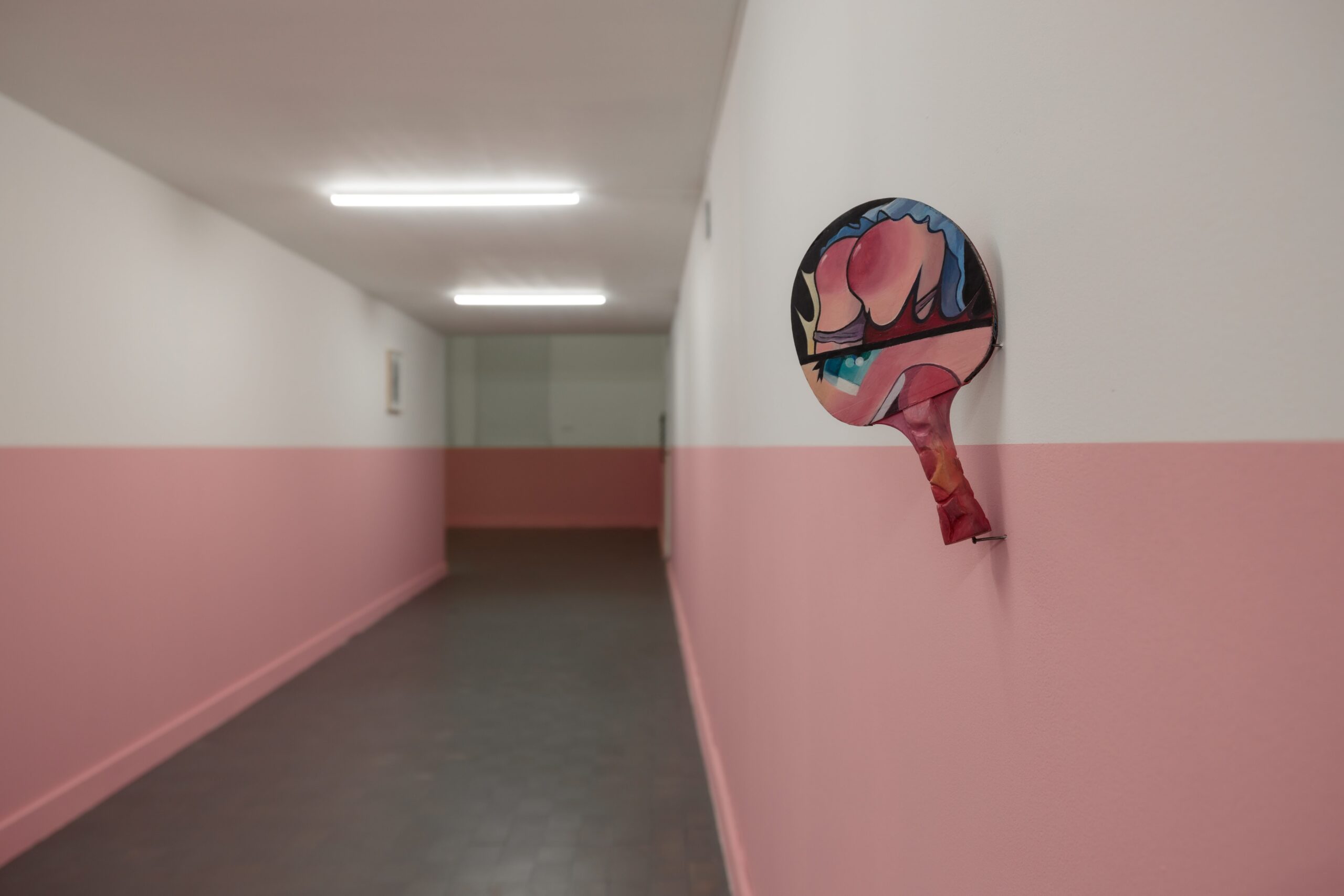
One of the most striking interventions is a corridor constructed on the upper floor. Sakowska explains that its form emerged partly from the room’s existing architecture, particularly an overhang that the artists decided to enclose. The resulting passage creates an intentionally uncomfortable transition into the exhibition. Fluorescent lighting, panelling and the confined architecture, as we know, tend to evoke in viewers associations with the unsettling spaces of the so-called Backrooms. Sakowska herself describes this passage as a kind of ‘oppressive entrance’.

The spatial arrangement therefore does more than accommodate the works. It establishes a physical experience of movement, restriction and transition. On the lower floor, meanwhile, the large windows remain open, allowing natural light into the gallery and offering a view towards the cathedral. The decision creates a dialogue between the exhibition and its surroundings, placing the works within a landscape already marked by architectural and institutional symbols.
A city without a single story
Szczecin is an important point of departure for the exhibition, but it is not its ultimate subject. For Sakowska, returning to the city where she grew up was significant precisely because personal experience can serve as a starting point for broader reflection. ‘I wanted to make the experience, in some way, shared and universal,’ she explains.
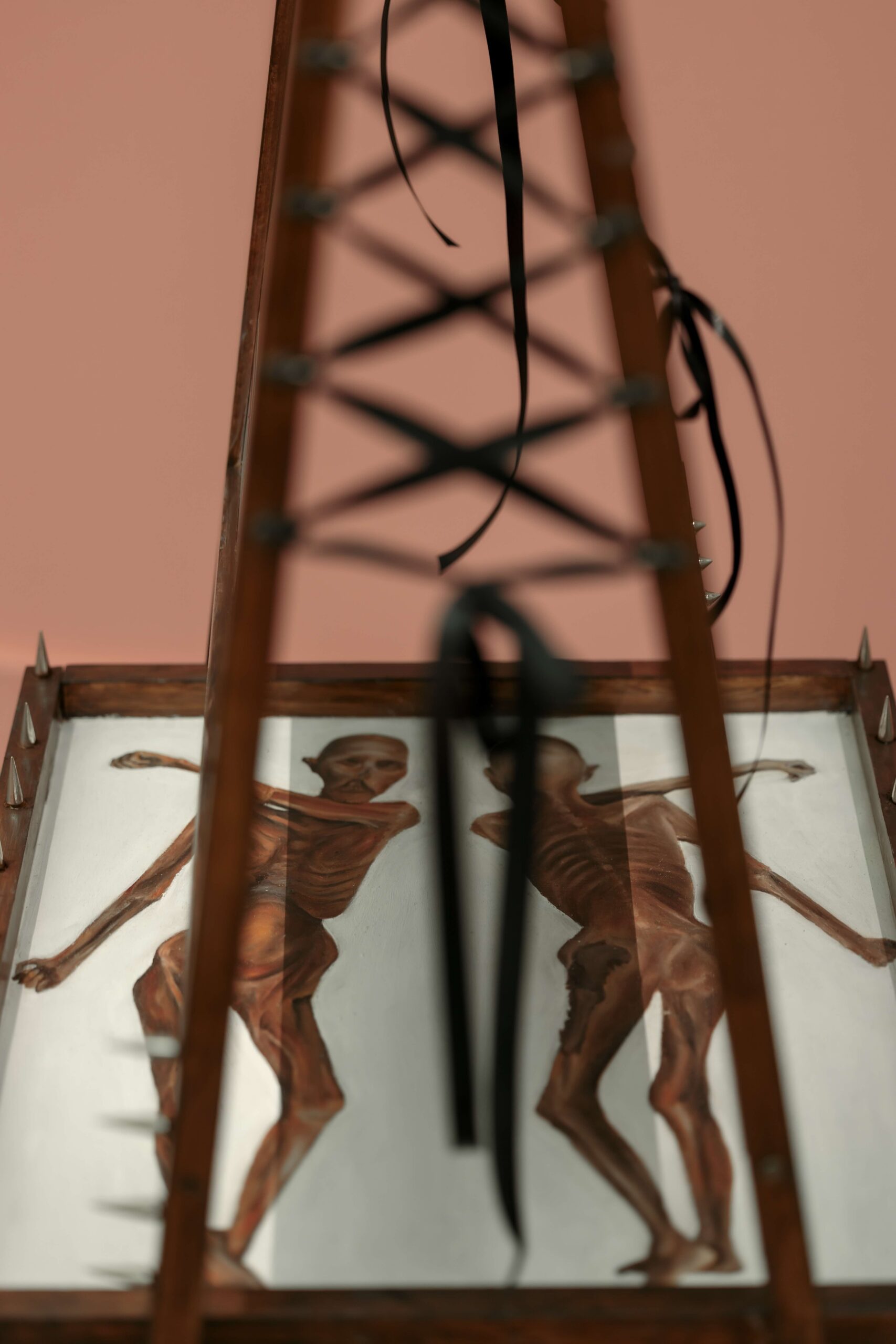
The exhibition draws on Sakowska’s experience of growing up in Szczecin, including her memories of school and of the Gothic and black metal subcultures of her adolescence. It also takes up the local legend of a black mass allegedly held at the Bismarck Tower in 1986. Rather than presenting these references as a strictly autobiographical narrative, however, Sakowska and Kosecki use them as fragments through which to explore how authority, social norms and cultural narratives become embedded in individual experience.
Kosecki points to a particular characteristic of Szczecin that makes it especially relevant to this approach. Unlike cities with deeply established local traditions, Szczecin has a more fragmented cultural history. Its architecture reflects different historical layers, while its contemporary artistic community has been shaped to a significant extent by people arriving from elsewhere. This contributes to what both Sakowska and Kosecki call a ‘patchwork quality and its multiplicity of threads.’

Patchwork as a way of seeing
Sakowska’s works frequently take the form of spatial constructions populated by objects, figures and images. Different references coexist within the same visual environment, sometimes establishing unexpected relationships between one another. Manga and anime may appear alongside references to European art history, while highly idealised fictional female figures are placed in relation to radically different cultural contexts.
For Sakowska, this patchwork quality is not simply an aesthetic choice. It is a way of organising knowledge. She describes her practice as a process of placing ‘objects, concepts and ideas’ into different spatial constellations, often within structures that are themselves layered and hierarchical.
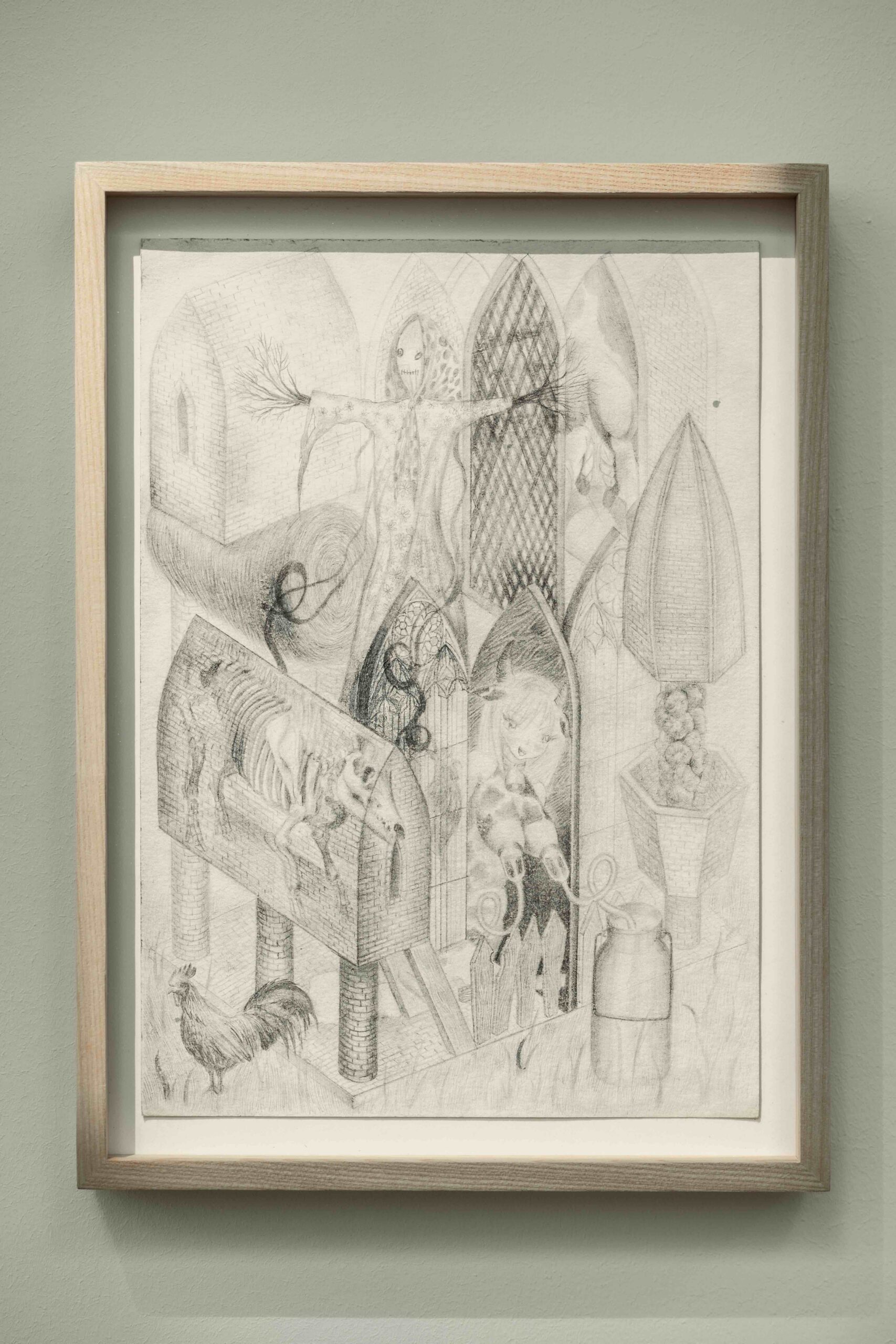
The resulting compositions reflect a contemporary experience of images in which radically different forms of culture are encountered simultaneously. Yet the apparent randomness of these combinations is deceptive. Sakowska is interested in searching for hidden similarities and analogies between sources that initially appear to have little in common. ‘This patchwork has many different functions,’ she says, ‘but for me it is a tool for constructing multi-contextual statements.’
For Kosecki, this multiplicity also produces a productive form of disorientation. The works do not offer a single visual language that can be easily decoded. Instead, different images reinforce and undermine one another at the same time. Removed from their original contexts, they lose some of their apparent certainty.

Kosecki argues that certain seamless aesthetic languages are easily absorbed and can be used by hegemonic narratives to conceal something, suppress discomfort or guide the viewer towards a particular interpretation without making that process apparent. Sakowska’s works operate differently. Their contradictions remain visible. The viewer is not allowed to settle too comfortably into one system of meaning.
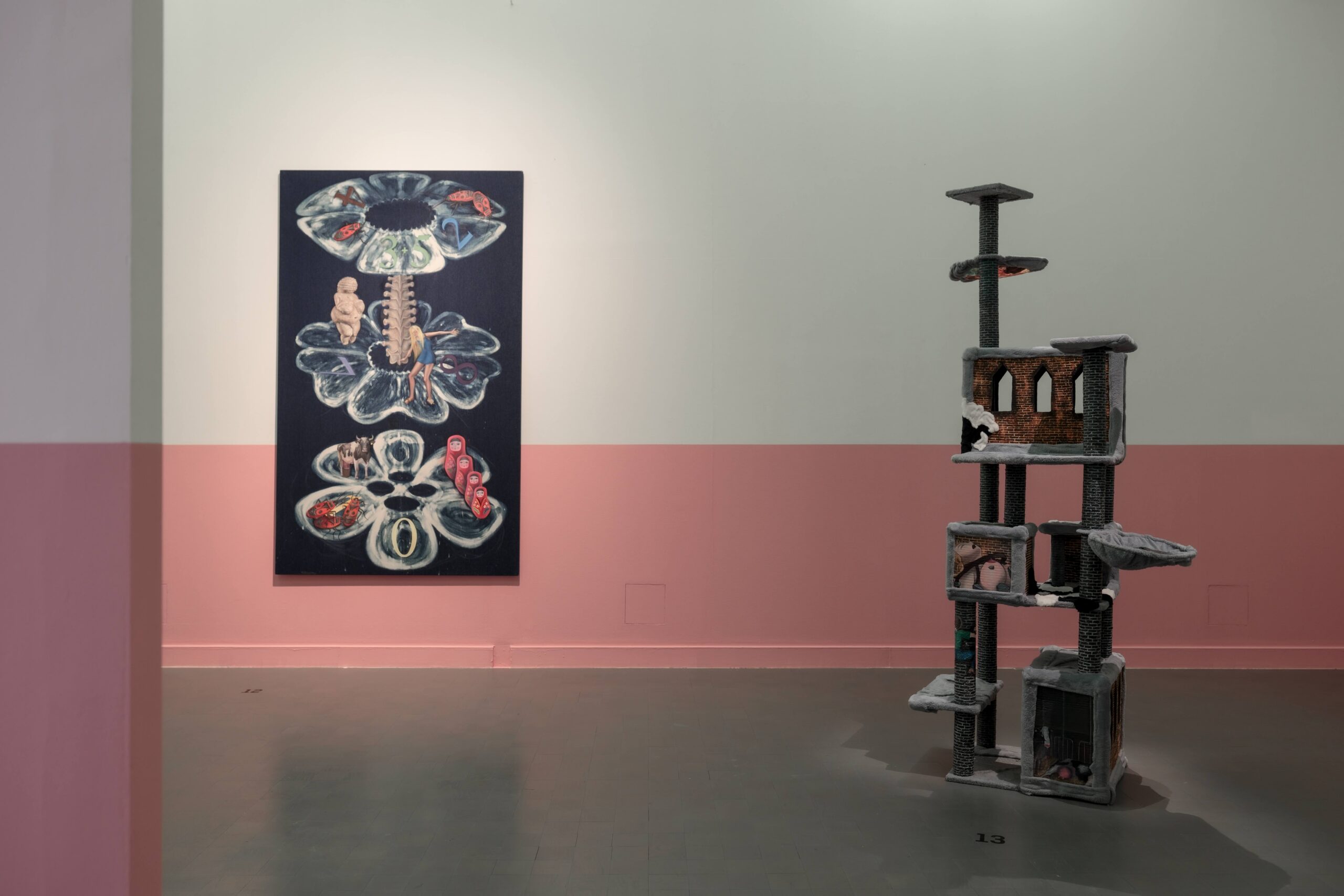
As Kosecki adds, ‘In Maryna’s Floral roulette series, different signs and visual fragments are brought together within compositions that recall Kabbalistic Trees of Life. Traditionally, such diagrams serve as tools of spiritual orientation, contemplation and the organisation of symbolic relations.’ Sakowska redirects this function toward symbols drawn from contemporary culture, using the image as a form of critical contemplation. Rather than pointing toward transcendence or rebellion, these works assemble heterogeneous signs into provisional systems, displaying the relations, hierarchies and assumptions that connect them. In this sense, the occult diagram becomes less a structure of belief than a model for thinking through images and their connections. The motif of the Tree of Life, a game of symbolic taxonomy enacted in the Flower Roulette series, gives the image something of the practical function once attributed to spiritual diagrams: not as a source of definitive answers, but as a tool for orientation and comparison.

The institutions that shape us
The question of authority becomes more explicit as the exhibition moves towards institutions such as the school and the Church. For Sakowska, these institutions provide a way of examining the systems of rules, values and expectations that organise social life and shape our most intimate experiences.
‘I am interested in how institutions function and how they shape us,’ she explains, referring to their influence on sexuality, interpersonal relationships and gender roles. Her approach is rooted in feminist thought, but rather than treating these structures as abstract political concepts, she examines how they are lived and experienced at the individual level.
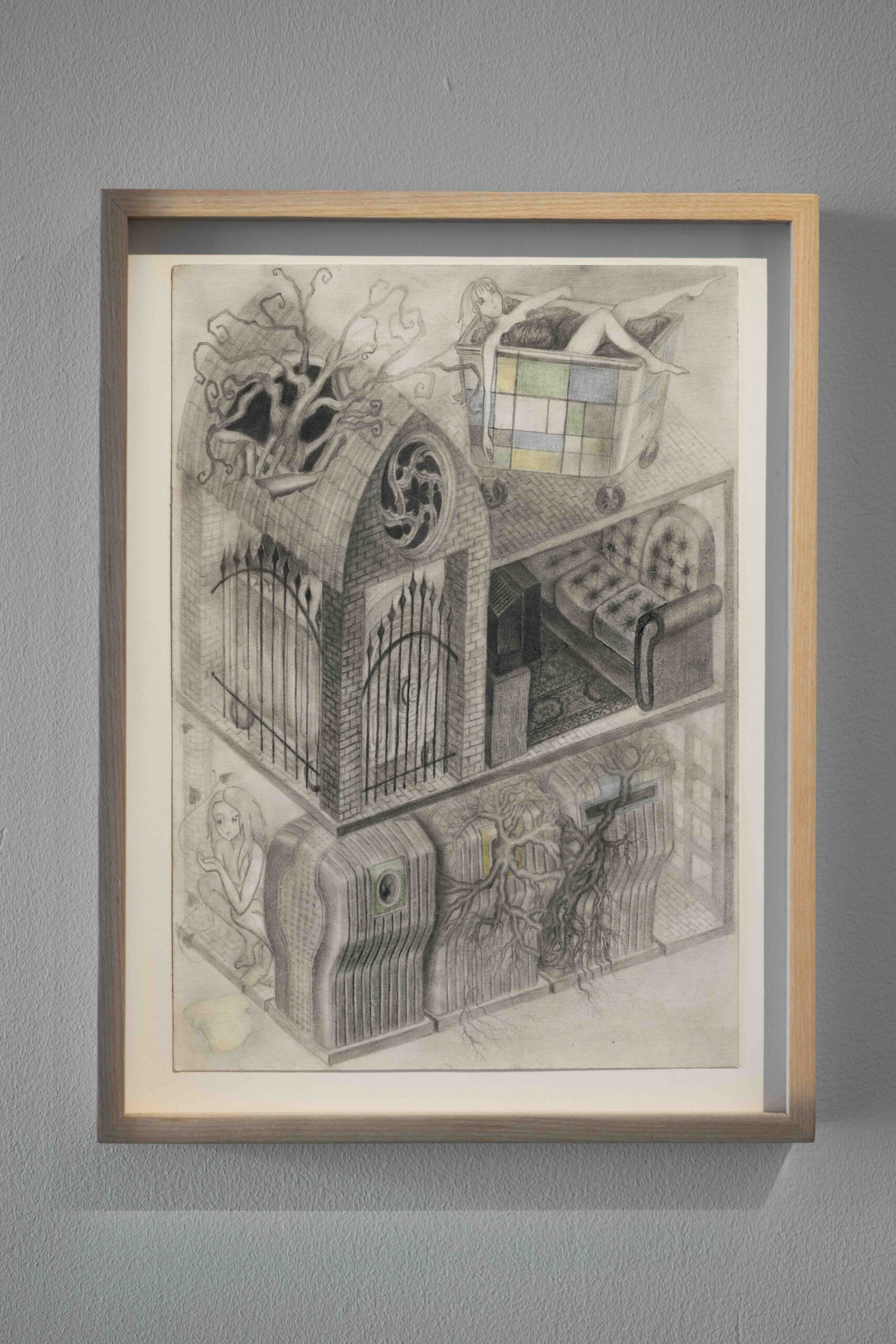
School is particularly important in this context. It is one of the first institutions through which a person encounters systems of rules, authority and social expectations. Kosecki describes it as a site of socialisation, a place where certain concepts and forms of behaviour are introduced and normalised. The school therefore becomes more than a setting or symbol. It functions as a model for understanding the production of the social subject.
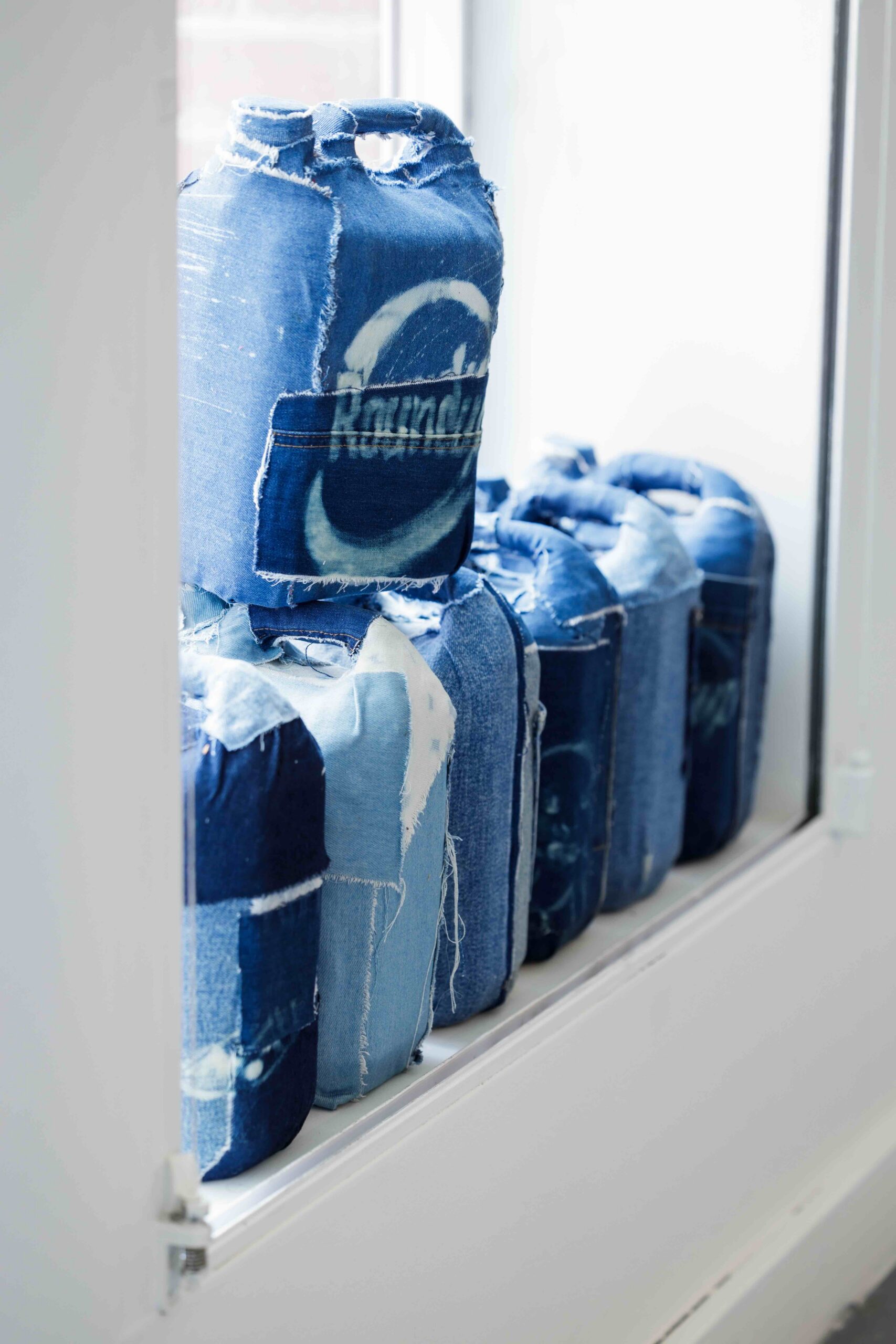
The upper and lower levels of the exhibition contribute to this narrative, with the school-related imagery giving way to an environment constructed from denim and denim paintings. As Kosecki explains, the ‘school environment’ on the 2nd floor can be understood as a kind of ‘factory’ producing what he describes as a ‘social skin’ that is displayed as denim works on the 1st floor.
Objects with a past
This interest in the structures surrounding everyday life is also reflected in Sakowska’s choice of materials. Instead of a canvas, she uses found and familiar objects, including ironing boards, cat scratching posts, denim and other everyday materials.
For Sakowska, this choice is inseparable from the meaning of the work. ‘I deliberately move towards using materials that already tell a story of their own,’ she explains. A found object carries a history that is not derived from the history of painting. It belongs to domestic life, work, consumption or leisure before it enters the gallery.
This familiarity is then disrupted by the painting placed upon it. Sakowska describes the effect as a form of brutalisation. An ordinary object, recognisable from everyday experience, becomes something else when confronted with an unexpected image or context.
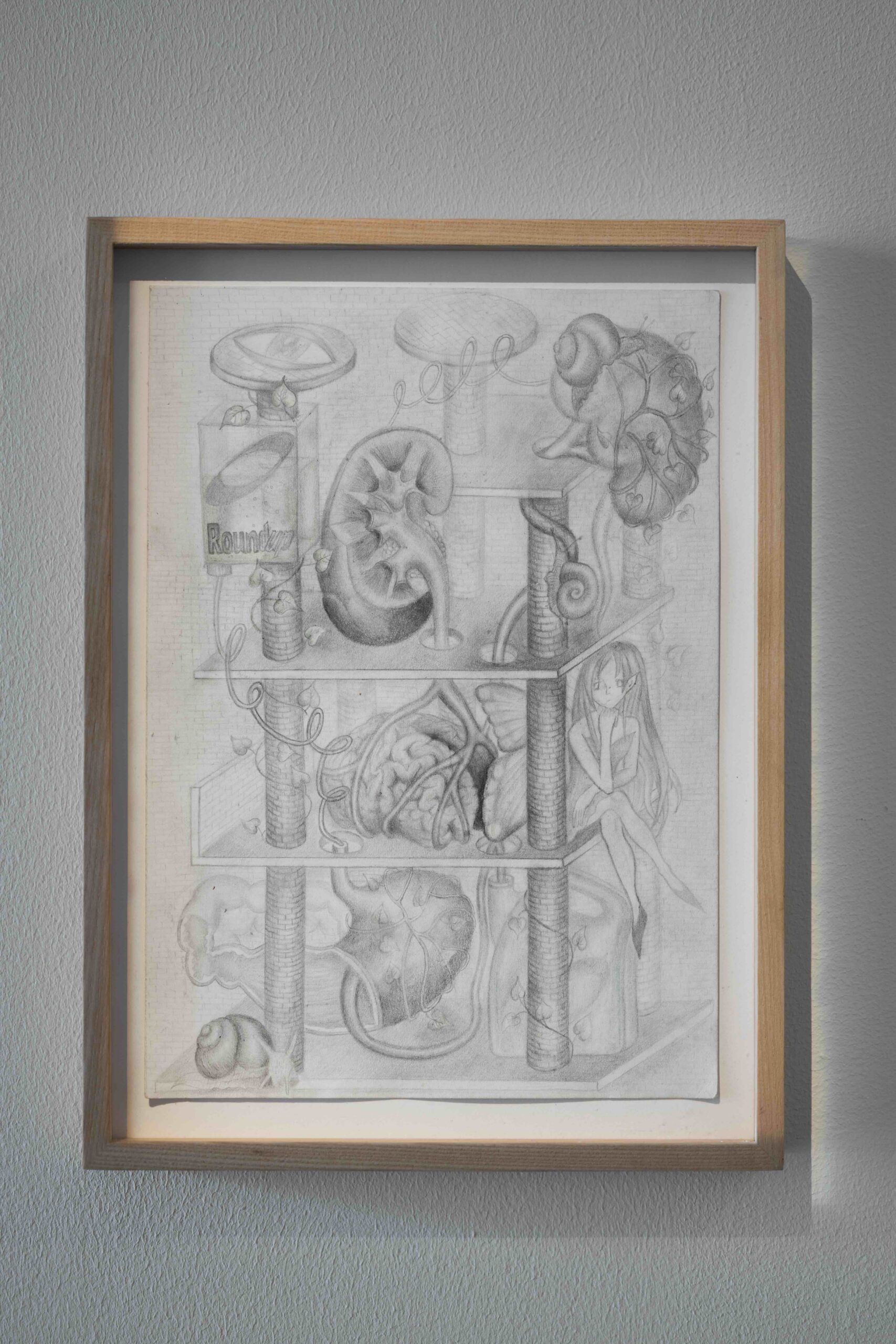
The cat scratching posts used by the artist are particularly revealing. Objects designed to create an artificial version of a natural environment for a domesticated animal become surfaces for images concerned with sexuality, oppression and social expectations surrounding women. The object thus acquires another semantic layer without losing its previous associations.
Denim functions similarly. Kosecki describes it as a kind of ‘social skin’, a material with a history that stretches from workers’ clothing to luxury fashion, while simultaneously becoming so ubiquitous that it risks becoming invisible. In Sakowska’s work, this familiarity is precisely what makes the material powerful. It is recognisable, ordinary and socially loaded.
The material is therefore never merely a support for the image. It participates in the production of meaning.
Not rebellion, but the anatomy of rebellion
At first glance, Ex cathedra might appear to be an exhibition about rebellion. Its references to black metal, satanism, counterculture and resistance to institutional authority seem to encourage such a reading. Yet both Sakowska and Kosecki resist describing the practice in those terms.
Sakowska is particularly cautious about interpreting her work as a form of resistance or struggle. ‘I do not perceive my practice as being against something,’ she explains. Rather, she sees it as a way of describing reality from the perspective of someone who is already situated within it. Kosecki similarly describes Sakowska’s work not as rebellion, but as ‘a kind of artistic and intellectual work around the medium itself, narrative and representation.’
This distinction is crucial. If the exhibition were simply an attack on institutions, it would reproduce a familiar opposition between authority and resistance. Ex cathedra is more interested in questioning whether such a clean separation is possible.
The endlessly falling authority
Kosecki describes rebellion as an element of the broader social machine. It emerges within the same structures that produce authority, rather than existing entirely outside them. In this sense, rebellion is not necessarily the opposite of the institution. It can also become one of its recurring components.
This tension becomes particularly visible in the exhibition’s treatment of religious and satanic imagery. The Black Mass provides one of the exhibition’s points of departure, while references to Satanism are not used simply as expressions of anti-religious provocation.
Instead, the exhibition draws on ideas associated with René Girard and the scapegoat mechanism. Small conflicts and rivalries within a community can become concentrated upon a single figure, whose exclusion or sacrifice restores a temporary sense of order. Violence, ritual and social cohesion consequently become intertwined.
Within this framework, the figure of the authority is never entirely stable. Kosecki describes the exhibition as presenting ‘a world of an authority that is constantly falling.’ Authority collapses, is relativised and replaced, only for another structure to emerge.
This also changes the meaning of the exhibition’s references to satanism. What appears to be an inversion of an established order does not necessarily dismantle the structure itself. As Kosecki points out, concepts can be reversed while ultimately serving the same mechanism. The surface changes, but the underlying structure may remain intact.
The result is a more complicated understanding of opposition. Turning an existing hierarchy upside down is not the same as escaping it.
Can we ever step outside the structure?
This raises one of the most difficult questions posed by Ex cathedra: if institutions shape us from childhood onwards, can we ever fully step outside them?
Sakowska’s answer is deliberately unsentimental. ‘We live in a society,’ she says, ‘and society simply consists of these different structures of power.’ Regardless of how we name or conceptualise them, we are structured by them from an early age.
The exhibition consequently does not offer a programme for liberation. Nor does it point towards a simple way out. As Kosecki puts it, the exhibition does not ‘point a finger towards any particular solution.’ Instead, its function may be closer to making these structures visible. Kosecki speaks of ‘making the social reality of institutions more malleable,’ opening up the possibility of changing the structures that organise our lives rather than imagining that we can simply abandon them.

This is perhaps where the exhibition’s apparent contradictions become most productive. The patchwork does not resolve itself into a single system. The found objects do not become neutral surfaces. The rebellion does not become a clean alternative to authority. The institution does not disappear.
Instead, Ex cathedra asks what happens when we become more conscious of the structures we are already inside. Its answer is not emancipation through escape, but a more difficult form of awareness: learning to recognise how authority is constructed, how it becomes embedded in bodies and objects, and how even resistance can become part of the same machinery.
The exhibition’s title, Ex cathedra, refers to speaking from a position of authority. Yet Sakowska’s works repeatedly destabilise the possibility of such a position. Meanings overlap, materials carry their own histories, images contradict one another, and familiar structures become strange. Rather than speaking from above, Ex cathedra invites the viewer to move through the structures themselves, encountering their contradictions from within.
Supported by TRAFO Center for Contemporary Art in Szczecin