When the Italian architect Marino Zancanella visited Poznań in 2024, his meticulous observations of the city’s local Renaissance architecture — most notably the structural geometry, rhythmic arches, and humanistic proportions of the Town Hall designed by the classic master Giovanni Battista di Quadro — did not merely result in a localised aesthetic appreciation or a transient exchange of professional courtesy. Instead, his encounter initiated a profound, highly dialectical dialogue concerning the memory of place, the elasticity of historical consciousness, and the persistent continuity of classic European architectural traditions.

From this rigorous intellectual exchange emerged the foundational curatorial framework of “parallel worlds.” This conceptual lens explicitly recognises that, despite deeply divergent post-war historical trajectories, disparate socio-political developments, and complex geographic demarcations, both the Venetian and the Greater Poland realities actively participate in the exact same history of forms, ideas, philosophies, and transcultural flows circulating across the European continent. It is by no means accidental or circumstantial that the physical continuation, materialisation, and ultimate fruition of this curatorial collaboration is realised in the exhibition La Villa | The Key to Art from Poznań, which took place between 5 and 23 May within the evocative institutional spaces of Villa Farsetti in Santa Maria di Sala, situated in the mainland territory of Venice.


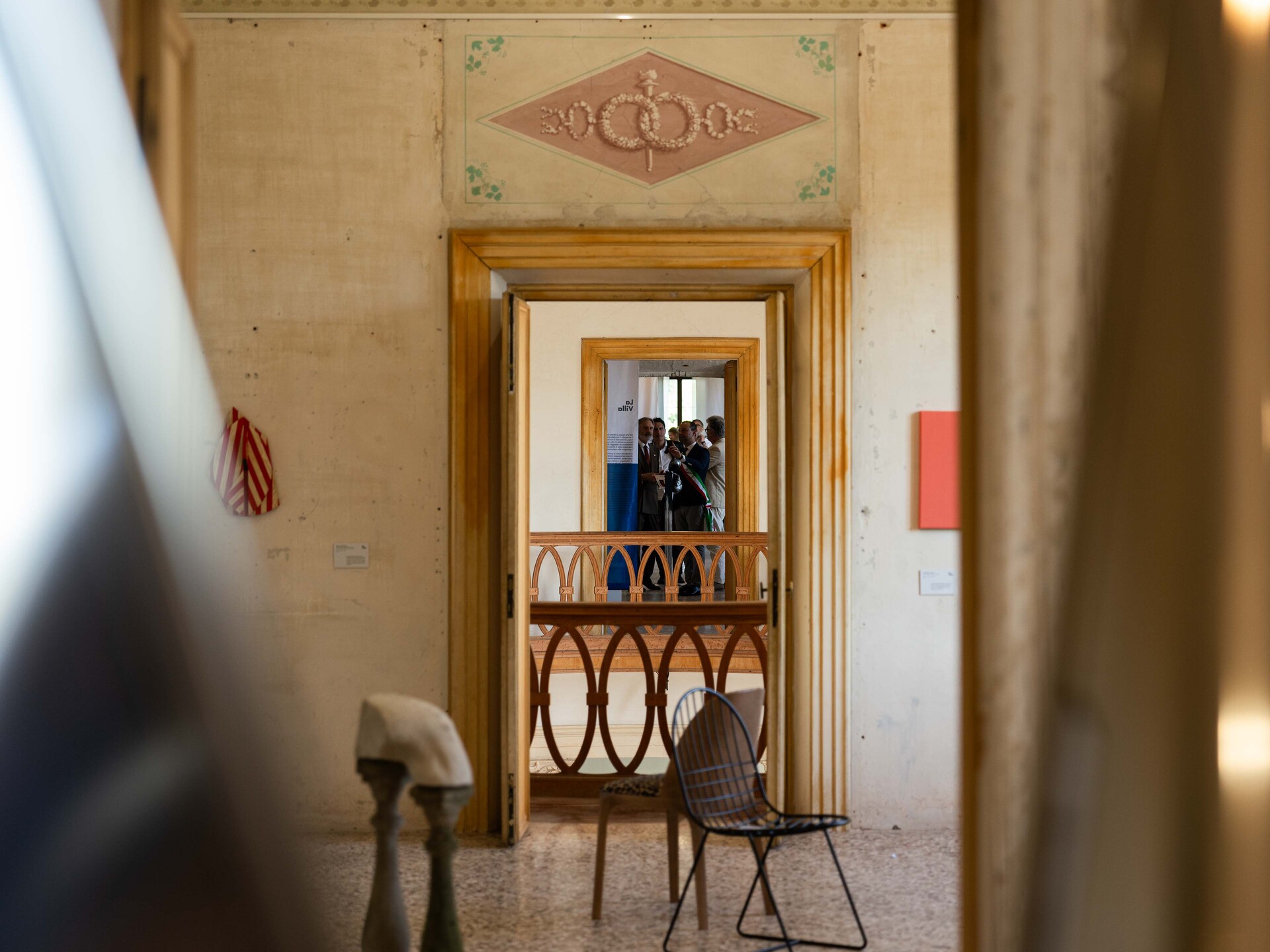
Deconstructing the Enfilade. The Academic Canon as a Critical Frame
Commissioned by the enlightened Venetian patrician Filippo Farsetti and constructed over a complex, thirty-year period between the mid-eighteenth century milestones of 1744 and 1774, Villa Farsetti stands as an architectural monument designed by the celebrated Sienese architect Paolo Posi. Once operating as a majestic, high Rococo residence explicitly built to function as a dedicated home for art — originally housing an extraordinary collection of classical casts, ancient antiquities, botanical anomalies, and Renaissance masterpieces — the estate has undergone a profound institutional transformation over the decades. Today, it is lovingly entrusted to the hands of the local municipality, serving no longer as an elite playground of aristocratic isolation, but rather as a living, breathing, democratic meeting place for the local community, civil initiatives, and grassroots educational projects.

The specific, highly regulated architecture of the building, which rigidly prescribes a traditional canon of academic beauty and neoclassical symmetry, serves here not merely as a passive background or a neutral container, but as an active conceptual frame for the subversion, expansion, and total transformation of classical academic values. Throughout the duration of the exhibition La Villa, which presents a polyphonic, deeply layered, and multi-generational portrait of the contemporary Poznań art scene staged within the critical international context of the Venice Biennale, architecture manifests as an inherently dialectical space for dialogue.
The specific, highly regulated architecture of the building, which rigidly prescribes a traditional canon of academic beauty and neoclassical symmetry, serves here not merely as a passive background or a neutral container, but as an active conceptual frame for the subversion, expansion, and total transformation of classical academic values.
Interestingly, while the exhibition adopts a seemingly traditional, linear layout that follows the villa’s historical enfilade of rooms, it utilises this physical, domestic progression to actively deconstruct the straightforward, teleological art-history narrative that usually dominates institutional spaces. Within this specific framework, triggered by Zancanella’s initial architectural reflections, academism is never treated as a calcified, closed archive of dead stylistic rules or dogmatic technical constraints. Rather, it is approached as an organic, historical language for organising visual communication, which is subjected here to a profound, highly contemporary reinterpretation.

Artistic figures from radically different generations, all connected at various stages of their creative, professional, and academic lives with the University of the Arts in Poznań (UAP), systematically rework traditional academic categories such as landscape, portrait, still life, the nude, and classical mythological themes, reading them entirely anew in the light of contemporary social and political issues. Within this curatorial subversion, the landscape becomes a scarred material record of the industrial frictions and ecological tensions between human expansion and aggressive urbanisation.
The portrait and the nude are wrested away from the objectifying, anthropocentric gaze of historical academies and converted into a highly politicised field of reflection on marginalised visibility, bodily vulnerability, and non-hegemonic subjectivity. Meanwhile, the still life and various mythological themes are ripped from their historic decorative contexts and weaponised as critical, allegorical commentaries addressing the systemic crisis of late capitalism, the violence of corporate extraction, and the decay of contemporary symbolic systems.

Centres and Semi-Peripheries — Mapping Asymmetric Dialogue
However, the historical and conceptual vectors binding Venice and Poznań gain a much deeper, critical dimension within this project. The entire structural skeleton of La Villa is firmly anchored in a broader, systemic reflection on the centre–periphery relationship, drawing directly upon the post-colonial and socio-economic theories of Fernand Braudel, Piotr Piotrowski — specifically his seminal concept of a horizontal art history — and Jan Sowa’s diagnoses of Polish semi-peripheral modernisation.
The exhibition masterfully demonstrates that cultural influences, aesthetic idioms, and artistic styles are never politically neutral; they remain irrevocably bound to historical frameworks of economic dominance, capital accumulation, and geopolitical prestige. Venice, as a historical epicentre of maritime wealth, mercantile power, and elite cultural curation, becomes a crucial point of reference for contemplating how structural patterns, artistic canons, and ideological systems generated in Western European centres were historically implemented, absorbed, or sometimes forcefully imposed upon the semi-peripheries of Central and Eastern Europe.
Venice, as a historical epicentre of maritime wealth, mercantile power, and elite cultural curation, becomes a crucial point of reference for contemplating how structural patterns, artistic canons, and ideological systems generated in Western European centres were historically implemented, absorbed, or sometimes forcefully imposed upon the semi-peripheries of Central and Eastern Europe.
Yet, La Villa refuses to remain stuck in a simple, melancholic diagnosis of cultural dependency, provincial lack, or passive assimilation. Instead, the curatorial framework points toward the liberating, radical possibility of creative assimilation — the capacity of the semi-periphery to strategically hijack, mutate, and transform borrowed, dominant forms into entirely new, universal artistic qualities. By doing so, the project forcefully rejects the vision of a hierarchical, vertical, and Eurocentric Europe in favour of a constellation co-created by productive asymmetries, local translations, and irreducible differences.
At the same time, it sharply accents the socio-political specificity of the Central and Eastern European experience, including the complex, material memory of the former communist state, reclaiming this historical landscape not as a site of trauma or ideological failure, but as a dense source of alternative values possessing horizontal, democratic, and deeply collective potential.

Local Colours and Scars of Memory. A Native Witness
As a native of Poznań, I must admit that experiencing these works within this specific Venetian context moved me exceptionally: reinterpreting local Poznań issues, urban topographies, and cultural phenomena that are deeply intimate, raw, and specific to those of us who grew up in the city or remain bound to its affective geography. I found myself truly amazed to assist in unfolding a cultural context that is so deeply familiar to my own identity, yet constantly shifting, shedding its skin, and evolving. This dynamic transformation occurs precisely because of Poznań’s highly active, resilient, and structurally rich artistic scene — a community of creators who are constantly working with the city’s artistic and cultural heritage while simultaneously acting as radical archivists of its contemporary ideological shifts.

I found the pieces marked by this sharp, uncompromising local colour to be particularly striking and conceptually devastating. The heavy presence of Rafał Jakubowicz’s photographs documenting the spatial boundaries of the Volkswagen factory in Poznań, captured in a project entitled Arbeitsdisziplin from 2002, instantly shifts the energy of the gallery space. The cold camera lens capturing the factory walls in terrifying proximity to a barbed-wire fence directly evokes the architectural shorthand of a concentration camp, reactivating the historical memory of industrial exploitation. It stands as a monument to the historical scandal of non-compliance with labour rights, systemic corporate overreach, and the economic censorship that attempted to suppress the artist’s work in the city decades ago.
A second piece that deeply affected me, especially from my personal perspective as someone who now permanently resides in Italy, was coming face-to-face with the documentation of Janusz Marciniak’s profound case study on the former New Synagogue in the Poznań city centre, entitled The Submerged Synagogue from 2026. This monumental structure, scarred by the trauma of its historical conversion into a public swimming pool by the Nazi occupation forces, and long left unresolved in the post-war urban fabric, poses a painful, urgent question regarding the ultimate ethical purpose, desecration, and collective memory of ruined monuments.

I was also deeply moved by the work of Lidia Tańska from 2025, entitled Head Held High, which speaks in a profoundly visceral, sculptural language of immense material weight and fragile transparency, beautifully illuminating how the civilised, rationalised human world remains intricately connected to the systematic abuse of the earth and the exploitation of other living, non-human organisms. This critical focus extends outward from localised urban scars to tackle the broader, pressing geopolitical landscape of contemporary Poland. Specifically, the exhibition weaves the harrowing, ongoing humanitarian and ecological crisis in the Białowieża Forest — the violent intersection of border militarisation, national trauma, and human rights violations — directly into the grand enfilade of the Italian villa, integrating national ecological trauma into the fabric of the exhibition.
Alongside these explicitly critical gestures, it was particularly important for me to simply witness the digital documentation of ephemeral performances situated in Poznań’s Freedom Square, known locally as Plac Wolności. Seeing that specific spatial void, the historic site of civil resistance, protest, and collective celebration, brought forth a wave of bittersweet nostalgia for situations that, due to my geographical displacement, I have not had the physical chance to experience for a long time.

Resonances in the Italian Imaginary. The Hauntological Bridge
Strolling between these historic rooms as a Polish woman who has lived in and navigated the cultural landscapes of Italy for seven years, I found myself deeply pondering a crucial curatorial question: What can all these highly localised contexts, raw sculptures, and conceptual reflections on the landscape, the body, and the Vitruvian Man presented from a distinctly Polish perspective truly communicate to an Italian public confronting these works face-to-face?

By systematically dismantling Western expectations of a singular, monolithic, or grey Eastern European aesthetic, the exhibition successfully provides the Italian public with a vivid, electrifying sense of what the Poznań artistic scene actually embodies, revealing a community that is incredibly varied, conceptually sophisticated, fiercely pluralistic, and aesthetically diverse.
By systematically dismantling Western expectations of a singular, monolithic, or grey Eastern European aesthetic, the exhibition successfully provides the Italian public with a vivid, electrifying sense of what the Poznań artistic scene actually embodies, revealing a community that is incredibly varied, conceptually sophisticated, fiercely pluralistic, and aesthetically diverse.
How does this dialogue among Polish artists, spanning generations and speaking in distinct registers of their own personal vulnerabilities, architectural histories, and political tensions, resonate within the highly charged setting of historic Venetian architecture?

The answer lies in the classic Derridean understanding of hauntology. Through La Villa, we do not merely view an exhibition; we gain direct, affective access to a spectral reservoir of reflections, historical ghosts, and local cultural anxieties that are vital to Poznań and the community that co-creates its reality. In this sense, the art ceases to operate as a passive, foreign showcase of regional talent. Instead, it manifests as a vital cultural practice co-responsible for actively shaping contemporary social relations, challenging the authority of linear storytelling, and building a genuine, uncompromised bridge into our shared European imaginary.
La Villa | The Key to Art from Poznań,
5 and 23 May 2026.
Villa Farsetti, Santa Maria di Sala