

Against the backdrop of Taiwan’s complex history, the 2025 Taipei Biennale explores the theme of Longing as an intrinsic driving force that perpetuates humanity, a kinetic energy that transcends the unattainable, knowing it cannot be grasped yet refusing to yield. It is both personal and collective, fragile yet stubborn; a thread connecting yearning to imagination and change.

Curated by Sam Bardaouil and Till Fellrath (co-directors of the National Museum of Contemporary Art, Hamburger Bahnhof, Berlin), this year’s Taipei Biennale – running till March 29, 2026 – brings together approximately 150 works by 72 artists from 37 cities around the world, including 34 new commissioned and site-specific works, encompassing painting, sculpture, video, photography, and performance.
The exhibition attempts to speak of the future in a low but firm tone, rather than a loud declaration. “Whispers” of a kind evoke the fragility of communication – those voices that persist even in silence, stories that continue even when erased. The horizon, like a dividing line between the visible and the invisible, evokes thoughts of distance, the future, imagination, and longing. Longing can be extended to humanity’s pursuit and contemplation of the past, the future, and loss amidst war, migration, and the changing times. This journey is like walking along the horizon: the closer you try to get, the farther away the horizon seems; and in the cacophony of life, those whispered murmurs become all the more precious.
“This journey is like walking along the horizon: the closer you try to get, the farther away the horizon seems; and in the cacophony of life, those whispered murmurs become all the more precious.”
It invites viewers to re-listen to those “whispers” on this journey where emotion and reason intertwine, and to find themselves and resonance in the process. The exhibition uniquely uses curtains instead of walls to create a fluid viewing experience; looking out from the exhibition hall, one can see aeroplanes taking off and landing, and the museum is currently undergoing expansion; looking inward, one travels between different eras and stories. Artists from around the world express the same emotions through diverse media, making us realise that the similarities between us may be more numerous than we imagine.

Grounding the Global in the Local
“We hope to create a biennial that can only be realised here, listening to the history, language, and contradictions that have shaped Taipei today. Our dialogue with the Taipei Fine Arts Museum’s collection is not a nostalgic act, but a grounding: when we persist in deeply engaging with local stories, the local can become a lens through which we view the world”, state the curators Sam Batavel and Till Farrath. “In Whispers on the Horizon, longing is that bridge; it begins at the intimacy of memory and extends to the shared horizon of locality and universality”.
Colonisation, migration, and ethnic resilience in Taiwanese history are aspects which collectively “embody a state of constant negotiation between belonging and displacement”. Therefore, a major task in curating the Biennale was to “create a space where feelings and thoughts, intimacy and structure can coexist without hierarchy”, connecting Taiwan’s local history with pressing global issues. These connections concern “the crisis of memory, the erasure of differences, and the desire for justice that shapes our shared present”.

Whispers on the Horizon suggests that the faintest whisper can redefine distance, and the subtlest gesture can rewrite the way we imagine the world. Before visiting the exhibition, it’s essential to clarify the meaning of “longing”. It’s an inner force that continuously propels humanity forward, a driving force that refuses to yield to things that are difficult to reach or control; it might be a desire for connection or a yearning for the unknown future; it could be a personal, private emotion or a pressing collective need; it possesses the ability to transcend national and cultural boundaries, evoking resonance, reflecting both deeply rooted human desires and providing a perspective for understanding our current situation.
The word “longing” may sound unfamiliar, but it’s a thought that has long existed in our minds and hearts. In a world where reality can be erased or forgotten at any moment, longing reflects a new yearning and urgency. The two curators interpret it this way: “Wherever we look, we are filled with longing: seeking the truth in the face of misinformation, finding belonging in broken communities, and yearning for connection in a time of division. The works in the biennial do not resolve these tensions, but rather make them concrete”. Stepping into the exhibition Whispers on the Horizon, you will realise that longing is no longer an abstract or historical product, but a vivid, urgent, and contemporary shared experience.

The curatorial inspiration comes from three objects closely linked to Taiwanese history. These objects, though not physically present in the exhibition space, serve as core metaphors guiding the exhibition’s emotional and temporal narrative. The male puppet in Hou Hsiao-hsien’s film The Puppetmaster (1993) symbolises the life of puppet master Li Tianlu, who dedicated himself to his art, embodying resilience through colonial rule and post-war reconstruction. The diary in Chen Yingzhen’s short story My Brother Kangxiong (1960) conveys the voice of a young man who committed suicide, struggling between faith and despair, reflecting a generation’s predicament between belief and disillusionment. And the bicycle in Wu Ming-yi’s novel The Stolen Bicycle (2015) symbolises a son’s journey to find his missing father, evoking themes of loss, inheritance, and belonging.
These literary and cinematic texts collectively lay the foundation for this year’s biennale, with three distinct interpretations of “longing” intertwining and resonating throughout the exhibition space: the male puppet represents continuity, the diary represents the inner world, and the bicycle metaphorically represents pursuit.

Longing materialised: the exhibition unfolds
The Biennale interweaves contemporary works with pieces from the Taipei Fine Arts Museum’s collection, with nearly 30 works from the museum’s collection distributed throughout the exhibition space, engaging in dialogue with newly commissioned and loaned works. The first-floor exhibition area primarily showcases works that explore the profound connections between dedication, memory, and resilience.
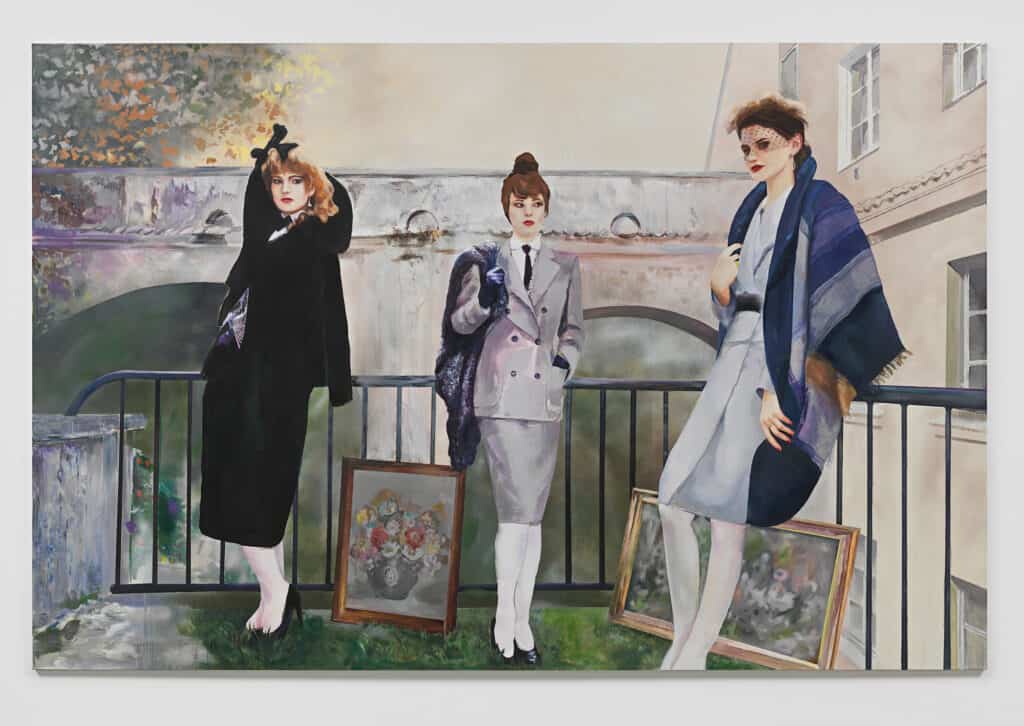
These works collectively illustrate how investing in craftsmanship, memory, and care can become a way of life. Among these works, Pseudo-Airfield (2025), by Chiu Tzu-yen, reconstructs an airfield used as a decoy during the Japanese colonial period. Through a Zero fighter plane handcrafted from iron frames and cardboard, and a video recording inside the cockpit, this on-site production blends historical facts with fictional narratives to examine the shaping process of collective memory. Chen Chin’s painting Fieldside (1934) depicts women in the fields with tranquil yet powerful brushstrokes. The elegant women in her paintings symbolise the spirit of Taiwan’s era of pursuing identity. Moreover, Afra Adahiri’s Intensified Pauses (2025) uses heavy, looping ropes to create a meditative layout, inviting viewers to use “slowness” as a form of resistance in a fast-paced world, while Sylvie Selig reinterprets mythological themes related to metamorphosis in her embroidery work.

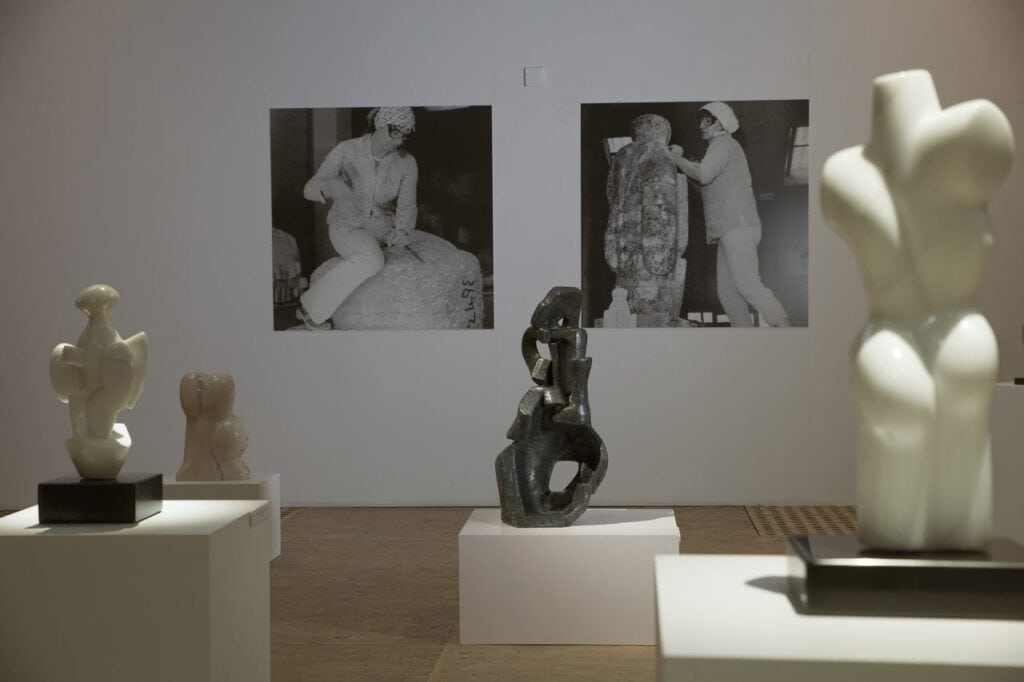
The second-floor exhibition shifts its focus to themes such as modernity, representation, and shared belonging. The exhibited works trace the lineage of modern art, shaped by a yearning for perception, interpretation, and connection, collaboratively reconstructing our imagination of the world through a contemplative perspective. Important works include Chen Cheng-po’s bright landscape paintings created in the 1920s and 1930s, presenting the changing landscape of Taiwan at the crossroads of eras and embodying a dialogue between local tradition and global modernism.
Meanwhile, Deng Nan-guang’s photography, Taipei, Taiping Town (I) (1942), documents urban transformation under colonial modernity, combines documentary precision with a cinematic perspective. And Taiwanese artist Chen Po-hao’s paintings intertwine stories about migration, family, history, and queer identity in Taiwan. Many of his works incorporate references to history and personal events, including his ongoing reflections on modern Taiwanese history and the queer liberation movement.
“The Biennale develops through a harmonic path of paintings, sculptures, installations, works on fabric, videos, and explores various expressive languages, blended into an exhibition composition that has the airiness of a Zen garden oscillating between dream and reality.”
In the final part of the exhibition, the works on the underground floor focus on the “body”, viewing it as a space where witnessing and transformation occur. The floor is like an underground mirror: here, viewers delve into their inner selves, and longing gradually becomes concrete through breathing, repetition, and ritual. Hsu Ching-po’s photograph Secret Talk (1956) captures two men leaning in to talk, with a bicycle beside them acting as a quiet hinge, both separating and connecting them, reflecting the recurring themes of pursuit and loss in the exhibition. Moreover, Álvaro Urbano’s Living Painting (The Stolen Sun) presents a silent theatre where objects emerge like ghosts in the changing light and shadow, intertwining with the Taipei Fine Arts Museum’s collection and blurring the boundaries between the museum and the stage, history and role-playing.

As such, the Biennale develops through a harmonic path of paintings, sculptures, installations, works on fabric, videos, and explores various expressive languages, blended into an exhibition composition that has the airiness of a Zen garden oscillating between dream and reality.
Taipei Biennale
November 1, 2025 – March 29, 2026
Taipei, Taiwan