
There is somewhat of a renaissance of late occurring in the contemporary arts scene, where increasingly more artists are probing their cultural heritage and digging deeper into their ancestral roots to inform and make sense of their present practice. Not entirely a new phenomenon, art’s shift away from the individualistic mindset in modernism – particularly the utopian, technologically-proppelled visions of Futurism – was already being noted by artist and critic Suzi Gablik in as early as 1984. In her book, Has Modernism Failed? Gablik argues that the greatest failure of the twentieth century was its navel-gazing discourse, which championed the lonesome figure of the artist-in-their-studio, severed from their community.

Considering that the old adage of history repeating itself rings truer than ever (just this August, there have been reports that Reform-run councillors in the countries of Staffordshire and Warwickshire in England are attempting to reduce the amount of LGBTQAI+ books and materials available in local libraries), it is no wonder that the value of working together, – of mapping what connects us, rather than divides us – has become an integral component and methodology for many artists working today. As the late Ana Mendieta, whose lifelong quest was to return to the very ‘maternal source’ of her identity, to honour her Cuban-heritage which had been lost to the annals of capitalism, stated: “This obsessive act of reasserting my ties with the earth is really a manifestation of my thirst for being.” As I enter the sweeping space of the Queen’s House in Greenwich, I learn just how communal this urge is.
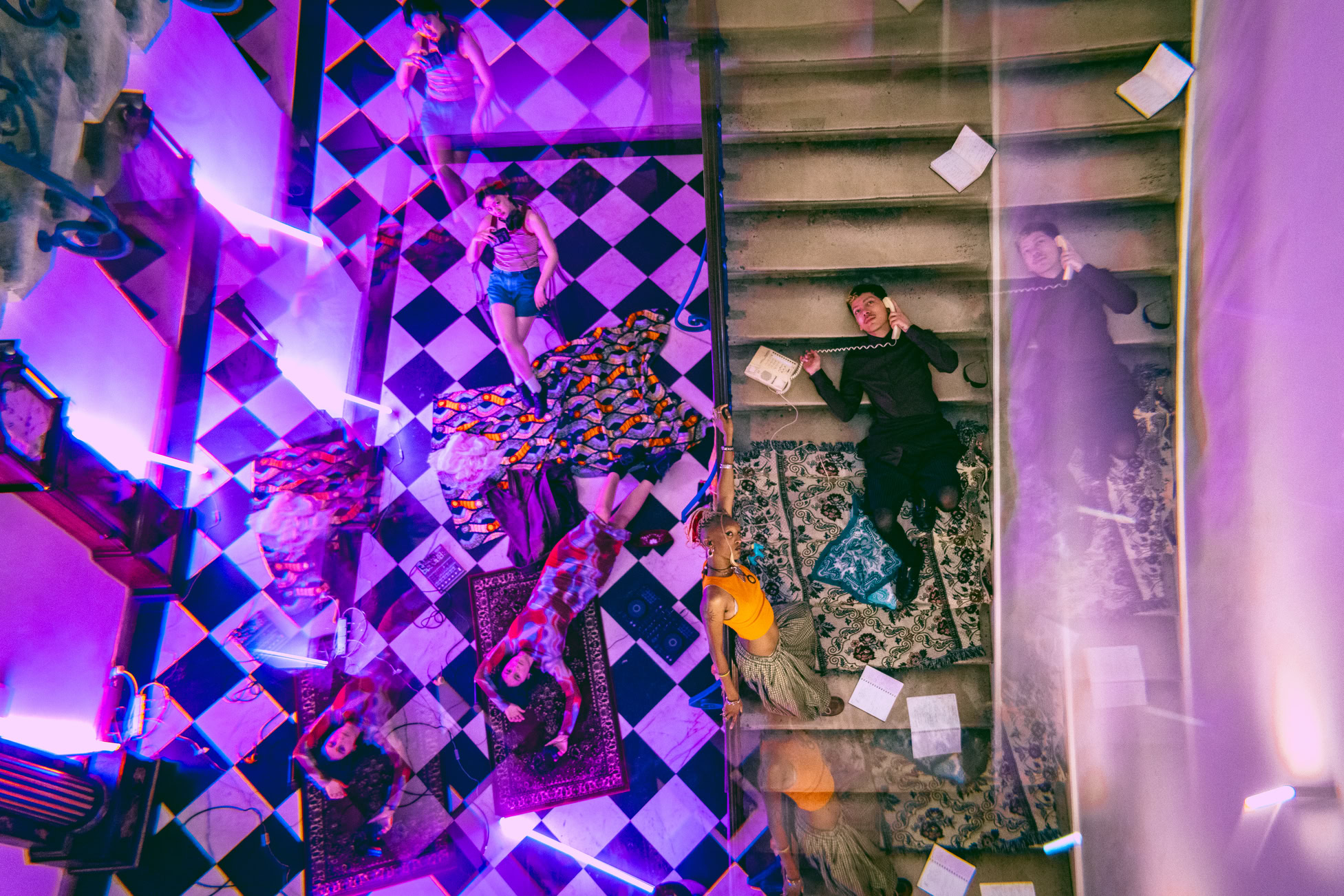
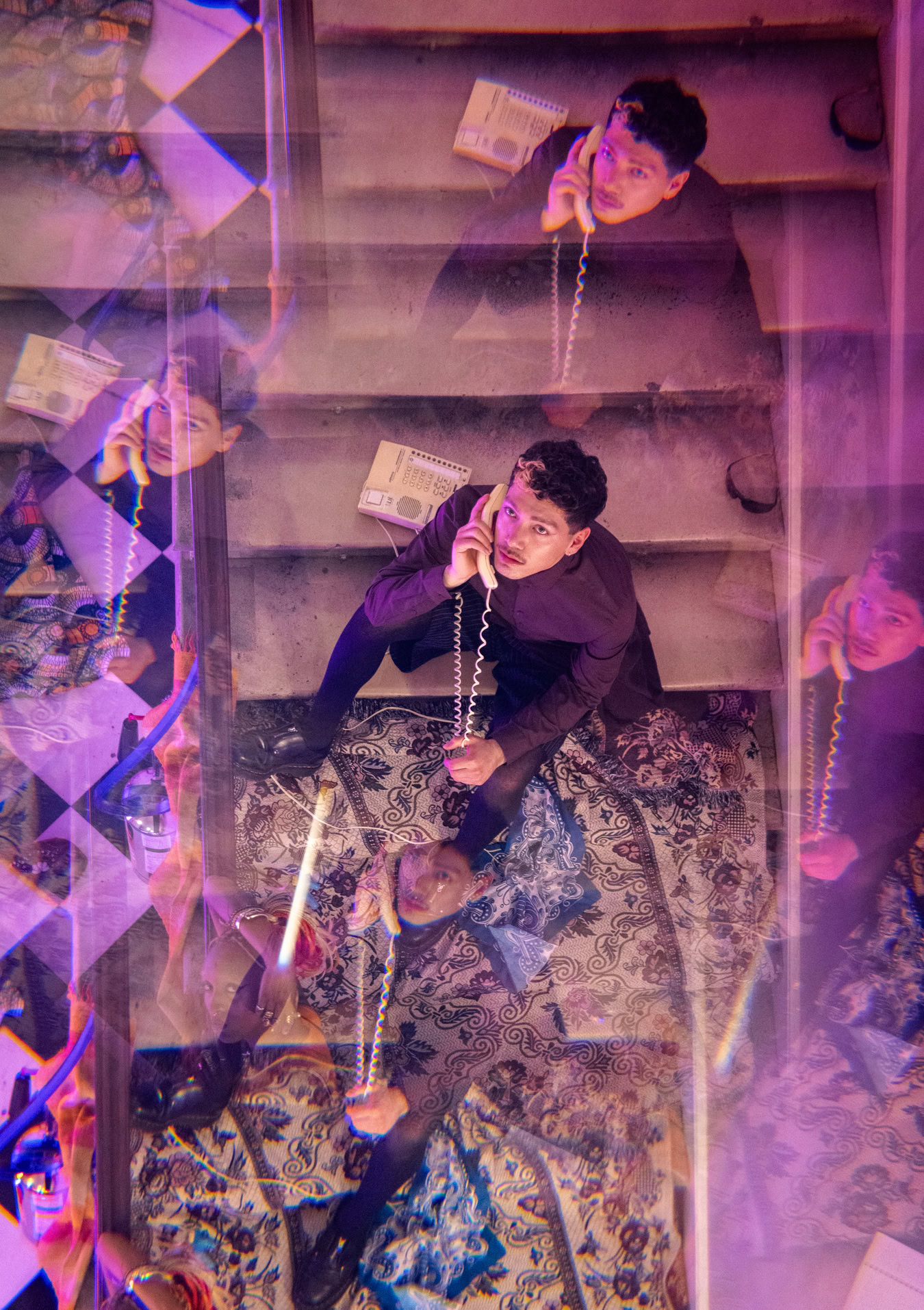
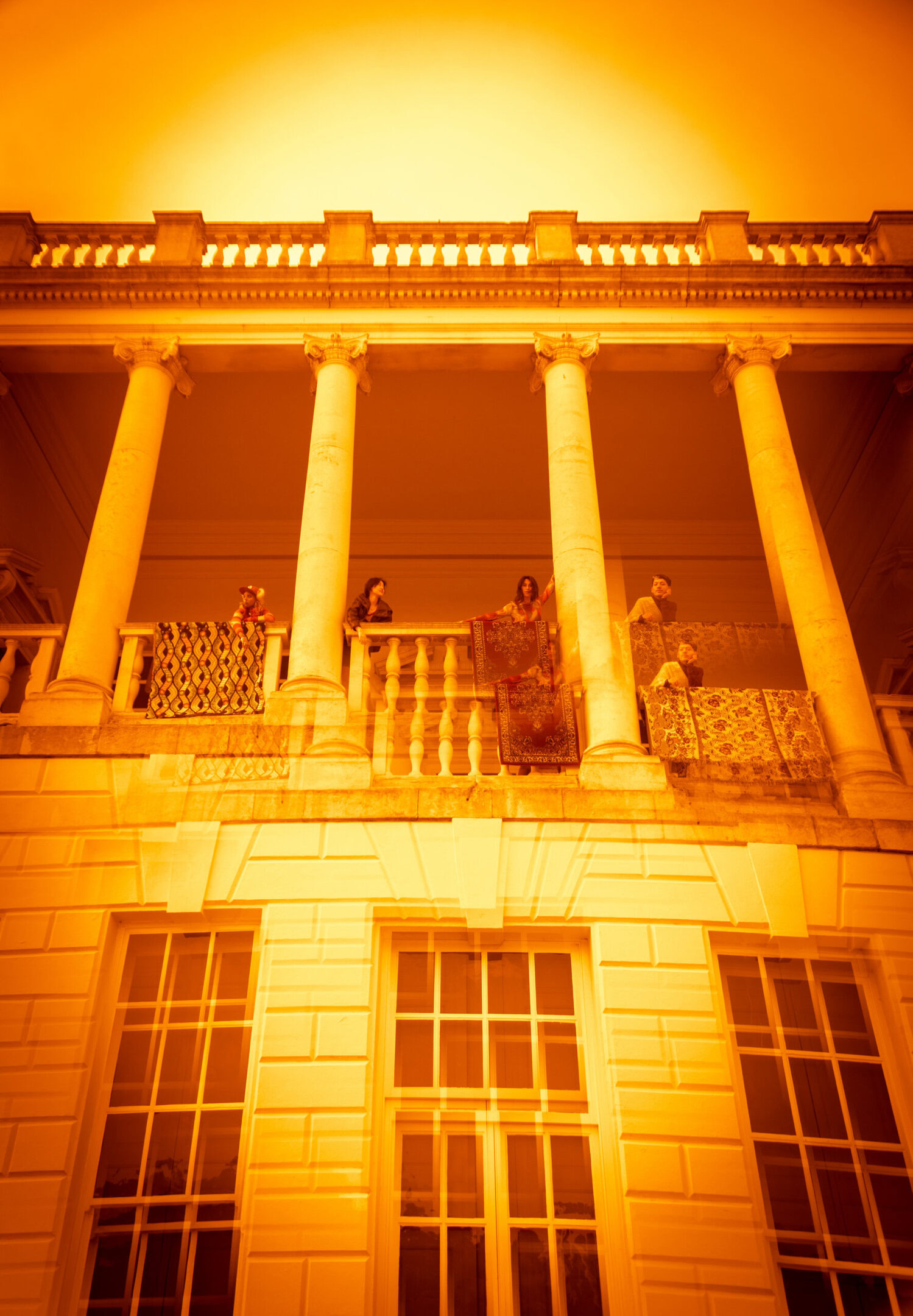
The Bold Mellon Collective – composed of Co-Founder & Artistic Directors, Emilia Nurmukhamet and Amy-Rose Edlyn, along with Lead Associate Artist, Dear Annie, have once again joined forces along with three London-based performers – HEAVADNY, Oscar Rodriguez and Chen Xu, to express, process and reflect on what it means to be a queer migrant in the capital today in their two-run live art performance, Queer Migrations (18 July 2026, Queen’s House, Royal Museums Greenwich, London). Marvelling at the intricate paintings of voyages and frenzied black ink comic-strip-like scrawlings of border crossing tales in the Crossings exhibition display, running co-currently with Bold Mellon’s event, I am suddenly scurried into an adjacent space, where a delicate lulling voice, paired with the melody of an acoustic guitar plucked softly, fills the cavernous grand staircase. It is HEAVADNY singing – their gentle prophecy salutes the audience amassed below, and signals the start of the performance.
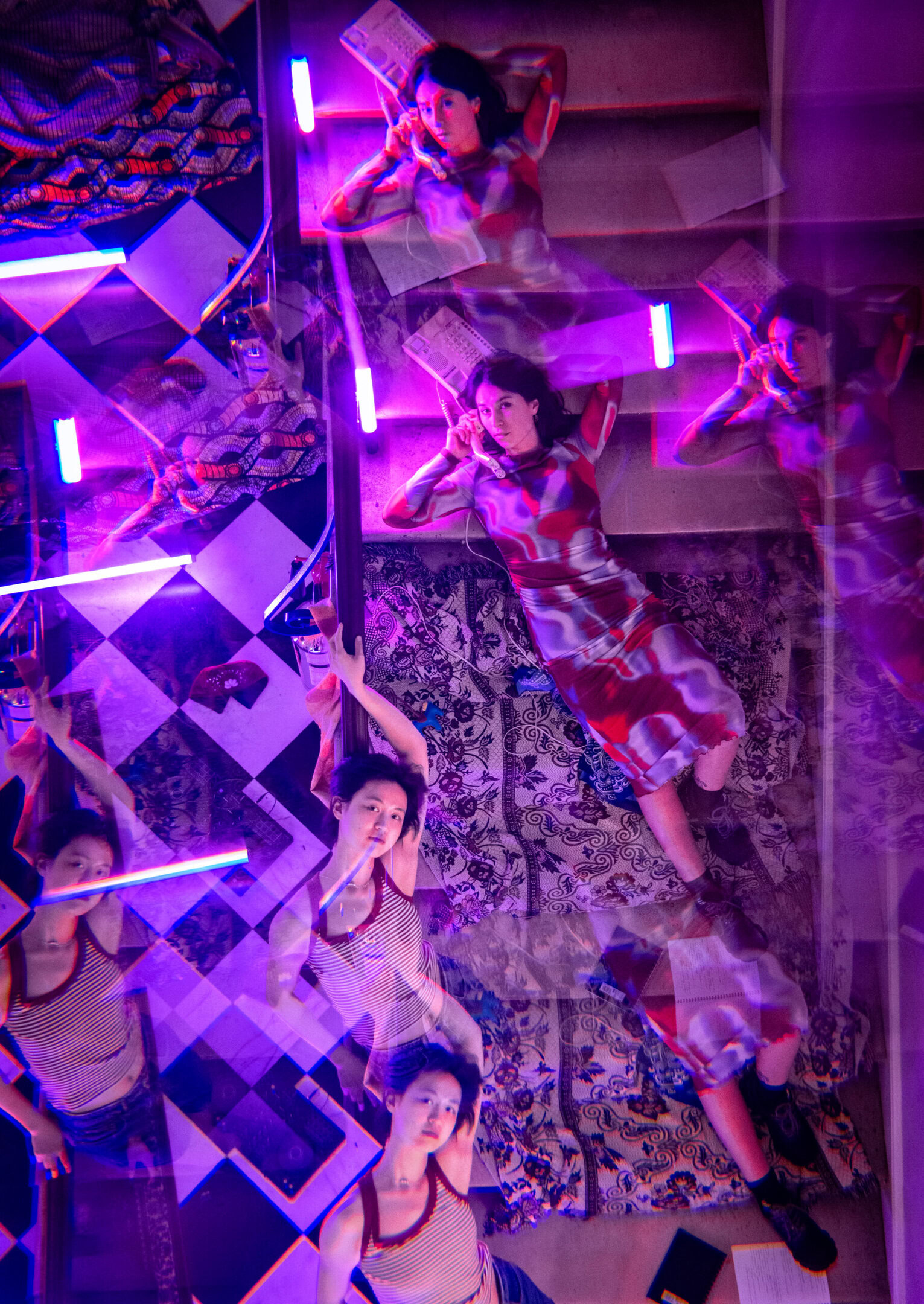
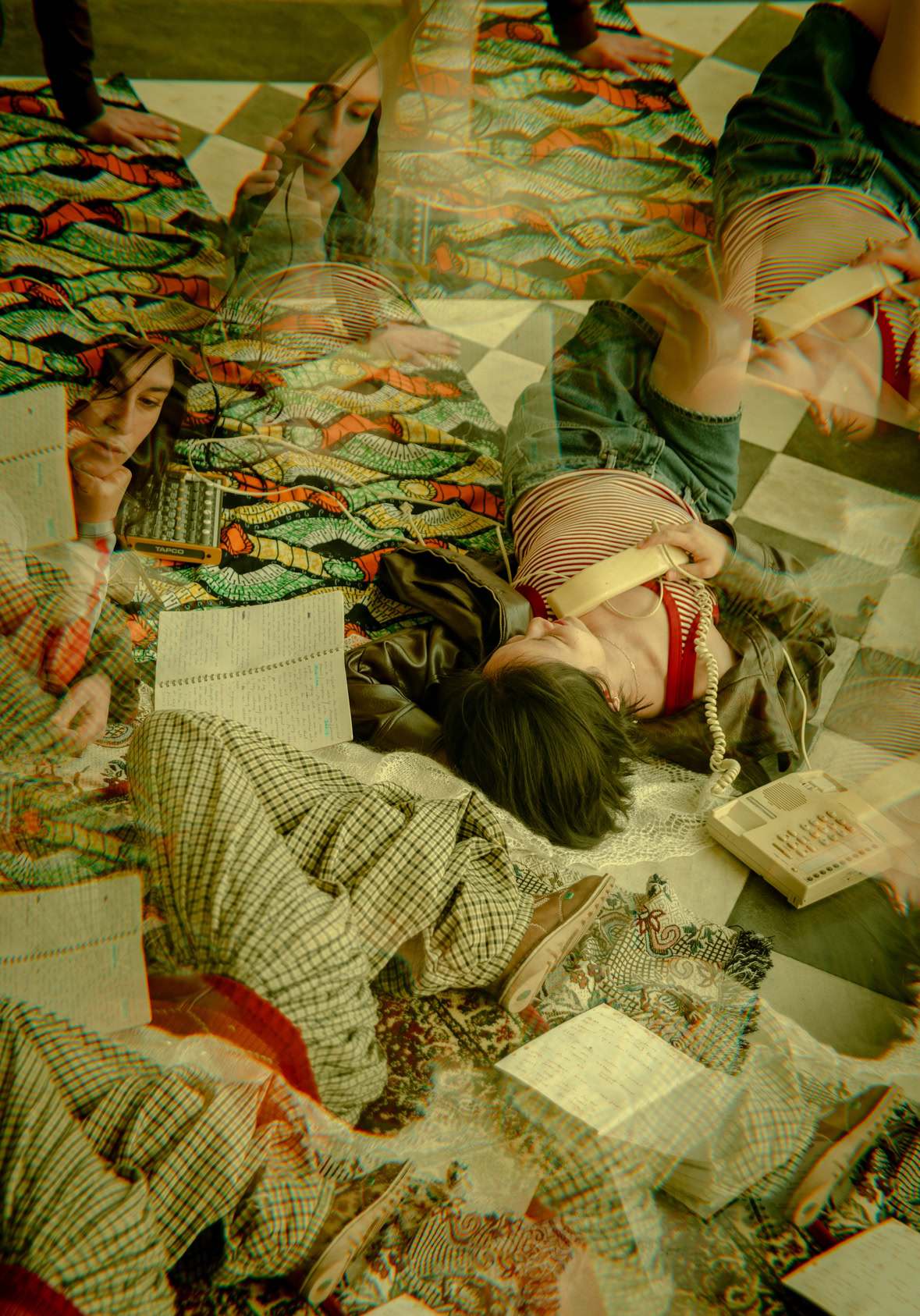
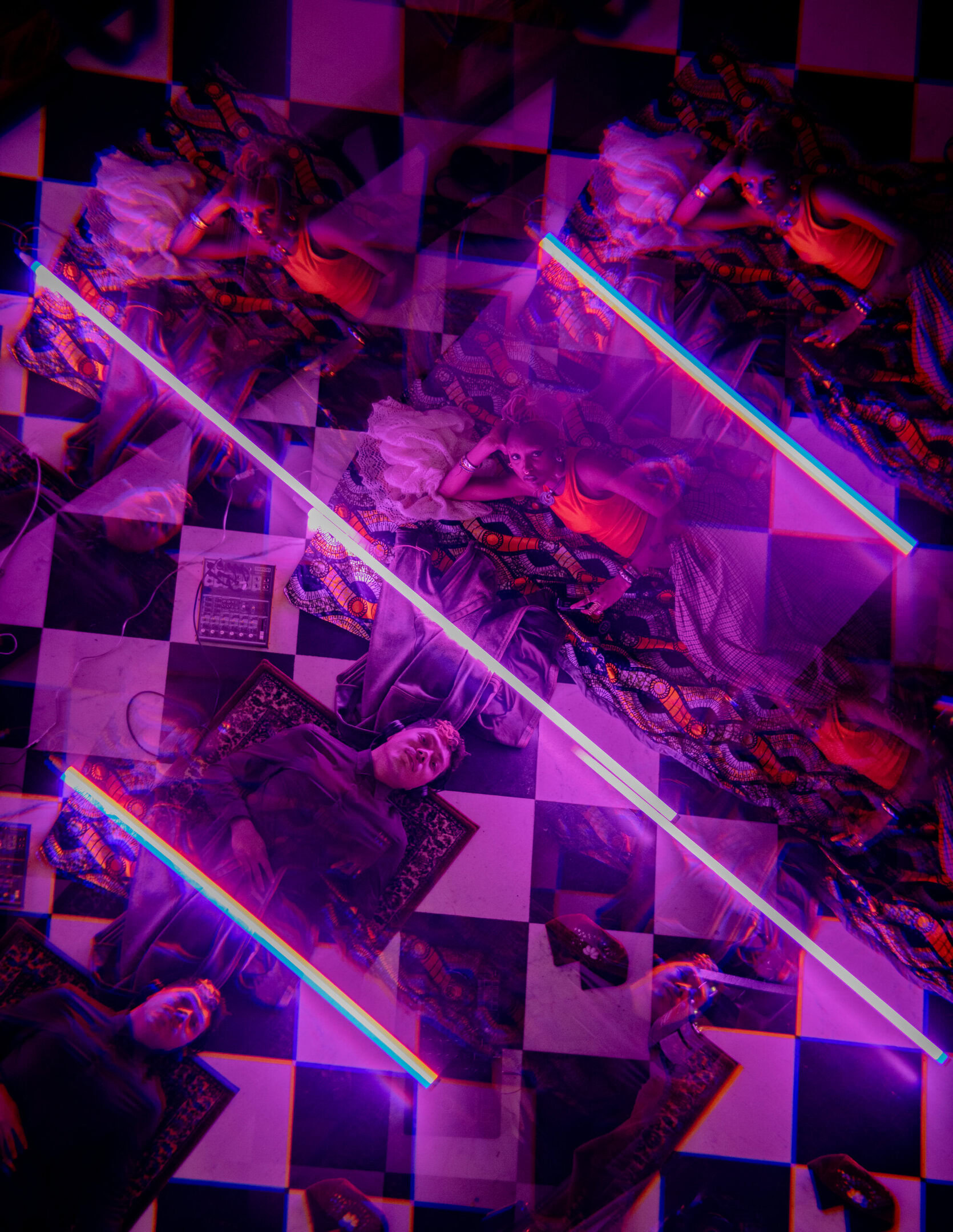
We are then whisked into the main hall, past the orangery – audience participation, or compliance, rather, is paramount to the performance (something we will return to later) – and assume a space cross-legged on the chequerboard floor. Now the heart of the performance, grounded in movement and fluid choreography, takes shape. My gaze becomes fixed on the four participating artists, who begin to glide from divergent corners of the room, propelling relics from their former homes – framed old photographs and books, stacked and rearranged in a multitude of perilous and unsturdy alignments, and swathes of traditionally printed fabrics, lifted in great, sweeping bellows, make their way towards a communal centre point. The effort and physical exertion in carrying these tangible memory stores, their literal weight and bearing on the body, does not go unnoticed. The performers writhe and twist and bend towards their end goal – reactions akin to the mental and physical journeys that those who have left their homes, wilfully or not, may face. Their arrival and fusion is also a kind of homecoming – like Mendieta who bathed her body in mud in Iowa, and burnished it into great trunks of plane and linden trees sourced while in Italy, their voyages can be marked by a constant metamorphosis, a journey made in order to return to their most alive, truest selves, to retrace the steps made by their ancestors.
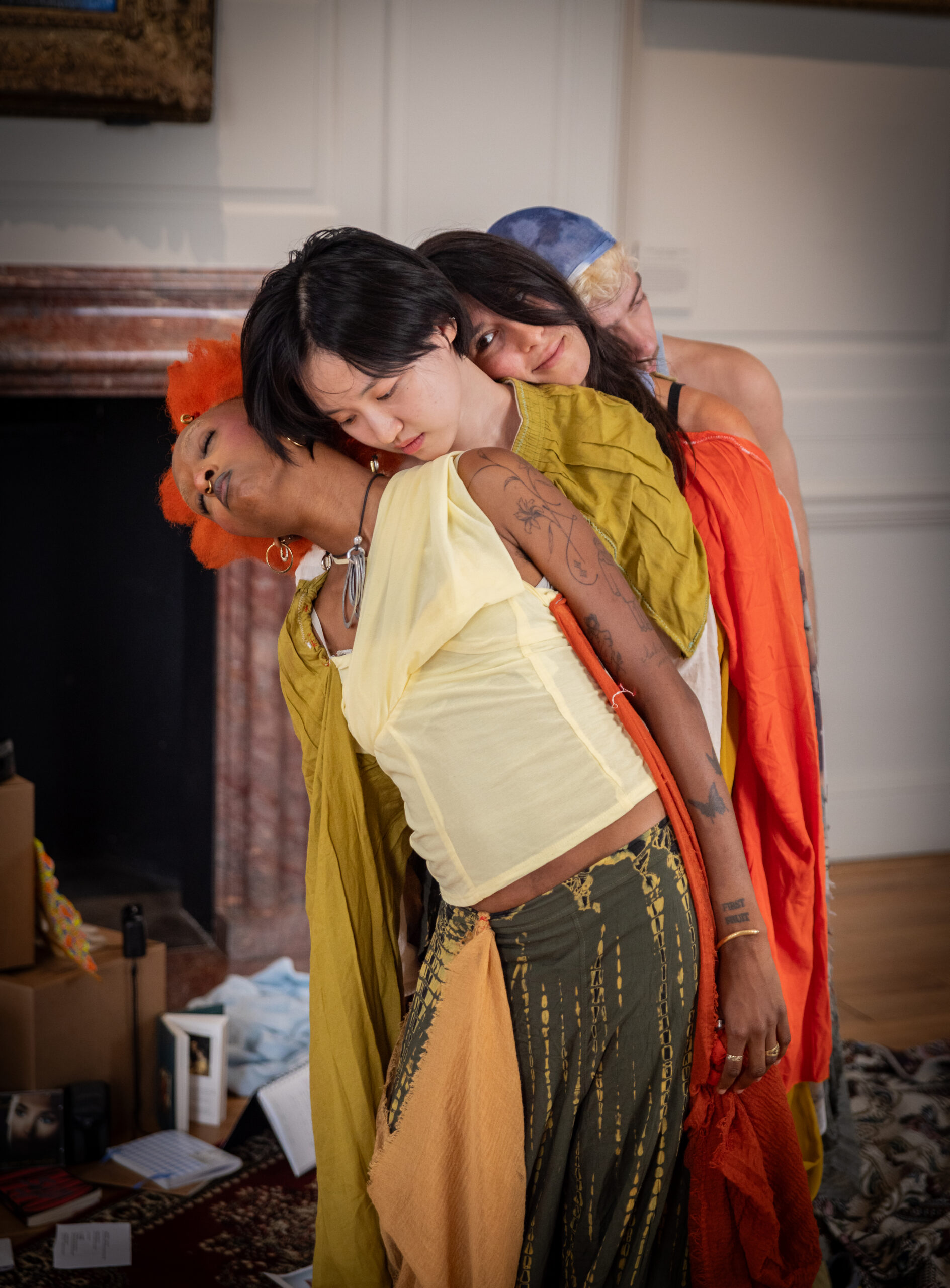
As the four performers become increasingly entangled, colourful bunting, bearing fundraising campaigns for refugees and political marches local and further afield, is held up by selected audience members, becoming a binding glue, a kind of protective force field for HEAVADNY, Oscar, Chen and Emilia. Bound by shared experience, they embrace and hold each other, as the closing words are uttered: ‘you are all who came before, you are all who will come after’.

Displacement, migration, soul-searching and longing are therefore not individualistic attributes, but a collective feeling that crosses generations. As the Queer Migrations performers prepare to launch the Queer Migrations Art Book this coming September 26th, Maggie Kuzan spoke to HEAVADNY, Oscar Rodriguez, Chen Xu and Emilia Nurmukhamet about their recent run of performances in a building steeped in Britain’s colonial past, the task of addressing political questions within their individual embodied practices, and the power found in joy, intimacy and collective action.
Maggie Kuzan (MK): This is the second time you’re presenting work at the Royal Museums Greenwich, an institution whose history is deeply intertwined with Britain’s maritime, colonial and imperial past. Last year you staged performances in the museum’s Ocean Court, along with an exhibition at Firepit Gallery on the Greenwich Peninsula. Returning a year later, were there conversations or stories you wanted to revisit? How has your project evolved, and what feels different this time?
Emilia Nurmukhamet (EN): Last year, we worked much more individually. We researched separately and then came together for this big performance day, and afterwards we didn’t see each other for almost a year. This time, however, the process was much more collective: we researched, played, made and wrote together. We would cut up our writing and stitch it back together, develop movements and use those as the foundations for the performance.
Many of the themes from last year remained: the role of the family, the colonial legacy of the building, the impact that history has on visitors, with an emphasis on how migrants are perceived within that space.
Oscar Rodriguez (OR): The collaborative process also pushed us to deconstruct some questions related to queer migrants – the role of borders and media coverage, larger themes looming underneath that identity. Eventually, we realised that the ‘larger’ could in fact be so abstract that we needed to narrow it down. That brought us onto obedience, which became the central question of the final piece. It still connects to broader narratives around capitalism and imperialism, particularly within the museum, but it gave us something specific to work with.
Chen Xu (CX): As Emilia stated, we worked separately last year, so there was more emphasis on personal stories. But this time, coming together allowed us to create not one collective narrative — because our experiences remain different — but a perspective beyond a personal migration trajectory.
EN: The wider context has changed, too. The UK is becoming more and more hostile towards many things we are representing, such as being migrant or queer. For example, our second rehearsal took place when all the protests were happening in Northern Ireland and people’s houses were being burned [a knife attack in Belfast, Northern Ireland, on Monday 8 June sparked a surge of public disorder and racially motivated violence across the country — Author’s note], and the Equality and Human Rights Commission (EHRC) has just introduced new guidance on 5 August that is incredibly anti-trans and awfully harmful. These identities and freedoms are beginning to feel increasingly precarious.
MK: Indeed. We must remember that art is never produced in isolation, but is very much responding and moulded to the political realm it finds itself in. Your performances this year took place just as the Royal Museums Greenwich welcomed a new rehanging exploring migration in the Queen’s House, Crossings. I’m curious to know to what extent were you influenced by the themes and artworks on display in this adjacent space? Were there any particular works or moments within the exhibition that resonated most strongly with you? How did those conversations find their way into the final performance?
HEAVADNY (H): There was one artwork, with a very small image of a young Black girl smiling, with an enormous border around her. I remember Oscar pointing out this detail, and we spoke for a long time about the metaphors within it and how the piece resonated with us. There was also a sound work, Shore to Shore (2026) by artist Güler Ates in collaboration with Leyla Huysal and Yusuf Huysal, which took on increasing importance, as we began to discuss further the history of the building, and what it physically allows or contains. Everything started to feel inherently linked: the artworks, the museum and what we were trying to make.
EN: We got to speak to Güler Ates and Shorsh Saleh about their respective works, and these conversations were instrumental in pointing us towards the eventual direction of our performance. I felt a responsibility on my shoulders, responding to another artist’s work, but Ates and Saleh were also very adamant about us being bold, not hiding behind abstraction and actually saying what we wanted to.
MK: Was there a clear story you wanted to tell, or was the message something that couldn’t be articulated and resisted traditional narrative?
CX: Determining what we actually wanted to say was probably one of the things we discussed the most. There is always a conversation between the form of a piece and the message it is trying to convey. You might begin with an intention, but then the work itself starts speaking. Our process involved generating material first and only then trying to understand how those fragments could sit together. Only then could we take a step back and ask: “What is this saying? Is it saying something we actually want to say? How does it speak to us, and how does it speak to the institution?” So rather than one fixed message, I think the work became a multi-way conversation.
OR: Everything became clearer once we identified obedience. Amy’s [Bold Mellon Co-Founder & Artistic Director & Queer Migrations photographer – Author’s note] recorded voice that functioned almost like a museum voice. Once that authoritative sound entered, another narrative emerged around the question of obedience – who gives instructions, who follows them, and why?
H: A big part of that was honesty. We kept asking how we could be honest in what we were putting on rather than simply performing a response. At certain points we were asking ourselves: ”Is what we’re making inherently political?” Once we understood that it was, it allowed us to become more sincere about what we wanted to bring into the space. The artists we spoke to had encouraged us to trust that honesty.
Determining what we actually wanted to say was probably one of the things we discussed the most. There is always a conversation between the form of a piece and the message it is trying to convey. You might begin with an intention, but then the work itself starts speaking. Our process involved generating material first and only then trying to understand how those fragments could sit together.
MK: Emilia, you’ve described the performance as reflecting something of what it feels like to live in this country as a migrant. How did that experience enter the work?
EN: Partly it was about finding your own space and coming to terms with somewhere new, that can initially feel very big, alien and uninviting, and asking how to make it your own. You bring things with you – photo albums, postcards, songs. In the soundscape accompanying our movement piece, the audience heard fragments of our families talking, singing or praying interspersed with familiar, home sounds, bird songs from our region, someone washing the dishes… There was this lingering presence of memory, which we had to treat carefully, because as migrants, there can be a constant expectation that you exist in the past. You are always being asked to look backwards, towards what you left or lost. We wanted to question that. How does one start anew, if your entire life afterwards is expected to become a reflection of everything you have lost and everything you are yet to become?
This line of questioning also extended to the sound design in the performance. As Oscar mentioned previously, Amy’s recorded voice became something like an institutional museum voice, an authority that supposedly knows better. As queer migrants responding to the site of the Queen’s House, we wanted to ask how society dictates the way you are supposed to behave. We wanted the audience to experience that question, too. When we are physically standing in front of you, but an authoritative voice is telling you something else, who do you listen to? Us, or the voice that sounds as though it knows better?
There was this lingering presence of memory, which we had to treat carefully, because as migrants, there can be a constant expectation that you exist in the past. You are always being asked to look backwards, towards what you left or lost. We wanted to question that. How does one start anew, if your entire life afterwards is expected to become a reflection of everything you have lost and everything you are yet to become?
MK: Even though the work deals with difficult political realities, joy seems fundamental to it. How did you avoid allowing the political weight of the subject to overwhelm the performance?
H: So much of the joy of what we made came from the process and the ability to play. When we were developing the movement, embracing each other and deliberately allowing more joy into the work, it created a lightness. Some of the material was heavy, particularly the collated poems and the gradual realisation of what that authoritative voice represented. Play and movement gave that material a space to breathe; it alleviated some of the heaviness.
CX: To me, it invites a larger question about art: how do you transform a political message into something that can actually be felt or experienced, rather than simply acknowledged? Experimentation, ambiguity and leaving room for interpretation are all part of that. Ambiguity can be protective, but joy, more importantly, is contagious. If the audience can sense some of this joy, then we’re conveying the message in a different way. It becomes an experience rather than something that’s just said.
EN: During one improvisation, we danced and then naturally came together afterwards. I remember embracing everyone and thinking, ‘This has to be in the performance.’ It was the most gorgeous thing, because that’s the whole point of being queer and being migrant and being in the sections of both. Because ultimately, it comes down to finding community. Community has become a bit of a buzzword of late, but there is still something real underneath it. And to me, it isn’t simply about finding community and then doing what society wants us to do – settling down, building a house, conforming; community should be about paving the way towards a better future for other queer migrants and marginalised groups. I wanted the ending to contain that fuzz that I felt during the devising when we all were together, but I didn’t want people to leave simply thinking: “Oh, that was nice to watch. What cute queer migrants.” The protest signs and bunting mattered, too. Being together is joyful, but there is a cause underneath that togetherness. We are there for each other.
So much of the joy of what we made came from the process and the ability to play. When we were developing the movement, embracing each other and deliberately allowing more joy into the work, it created a lightness.
MK: Alongside the performance, the Queer Migrations Artist Book is also launching on 26th September. How does the publication extend these conversations?
EN: We received around one hundred submissions, and what was exciting was the complexity of the conversations people were having with themselves. Something we discussed throughout the project is that being queer and migrant in London is not the same as being queer and migrant somewhere else in the UK, let alone elsewhere in the world. Place changes your experience, determines your community.
The submissions span visual work, poetry sculpture and creative writing, so the book brings together many different perspectives. It will also include contributions from organisations working directly with queer and migrant communities, such as Micro Rainbow. It was important to me that the book exists in a community-oriented space, as well as in relation to the museum. The publication can travel differently from a performance and create another space for those voices.
MK: Are there any artists, organisations or grassroots initiatives you’d like to highlight that are doing important work with queer and migrant communities and could use wider recognition?
EN: Queer Migrant Pride Fest at St Margaret’s House is one. It creates a genuinely community-led space. Micro Rainbow and Minority Inclusion Front are also doing important work.
OR: I went to Queer Migrant Pride Fest this year and what stayed with me was that ‘community’ wasn’t simply a word being used to describe the event. People were actually talking to one another, exchanging stories. I remember being there while we were developing this performance and thinking: I want all of you to be part of this. I want all of you to perform this someday instead of me. I wanted more of that exchange.
I also co-run Knots, a noise-art cooperative that organises fundraising events centred on experimental sound. We use noise and cross-disciplinary performance to platform different collaborations, with each event raising money for a different direct-action group. That practice has reinforced for me how powerful sound can be, but also how artistic practice can materially support other forms of organising.
MK: Finally, the term ‘queer migrant’ brings together identities that are constantly being negotiated and redefined. What does the term mean to you personally?
H: My relationship to it has many layers. My mum was born in West Africa and moved between countries there, before eventually arriving in Manchester, and then London. So, there was so much movement before she even reached the point of settling here, and she faced enormous difficulty. I’ve only recently learned this in the past five years, as she passed away when I was a child. When you are younger, you don’t necessarily understand what it takes for somebody to establish a life in another country. Even though I was born in London, I’m directly affected by my mother’s journey and this appears in my work as a songwriter and a performer. In the section of the performance where we brought pieces of ‘home’ together, the objects I contributed belonged to my mum. Another layer appears, once you place queerness on top of that. My relationship to ‘queer migrant’ contains all of those histories. Art is often the only way I know how to express them.
CX: I also feel like a lot of stories and conversations are missing. I sometimes wonder whether, in a few years, ‘queer migrant’ will feel too broad as a term, or perhaps like a box that has become too tight. The conversations we had while making the work made me recognise categories that had been imposed on us without me necessarily realising they were there. That is why creating spaces where people can actually have these exchanges is so important. Maybe we need to expand the term before we can understand its limits.
I also find that migration and queerness are often separated culturally. There is migrant literature and queer literature, and sometimes I have to consume them separately in order to feel both parts of myself acknowledged. Making something where those experiences can coexist therefore feels significant. There is a line at the end of our performance: ‘You are all who came before; you are all who will come after.’ To me, that isn’t only about biological ancestry. There is also an intellectual and queer lineage – generations of exploration that have allowed us to understand ourselves in the ways we do now.
EN: Exactly. The ancestry is not about the bloodline, but also about the queer people, the queer migrants who came before you, as well as those of the next generation. What kind of future are we creating for them? How much are we fighting against obedience? What more can we do – through art, through conversation, through research, through building communities or creating families in whatever form they take?
I remember when we first got together, our experiences felt intensely individual. For a long time, I thought the painful parts of my migration story were simply my pain to carry. But the more we talked, the more we realised all these different connections we’d had, that there are things that can still be spoken about and felt together. That became the purpose of making this performance -the tenderness of holding each other’s grief. Not only our own grief, but that of our parents and grandparents. Not pinpointing them but intertwining them in a way. That made my summer, really.
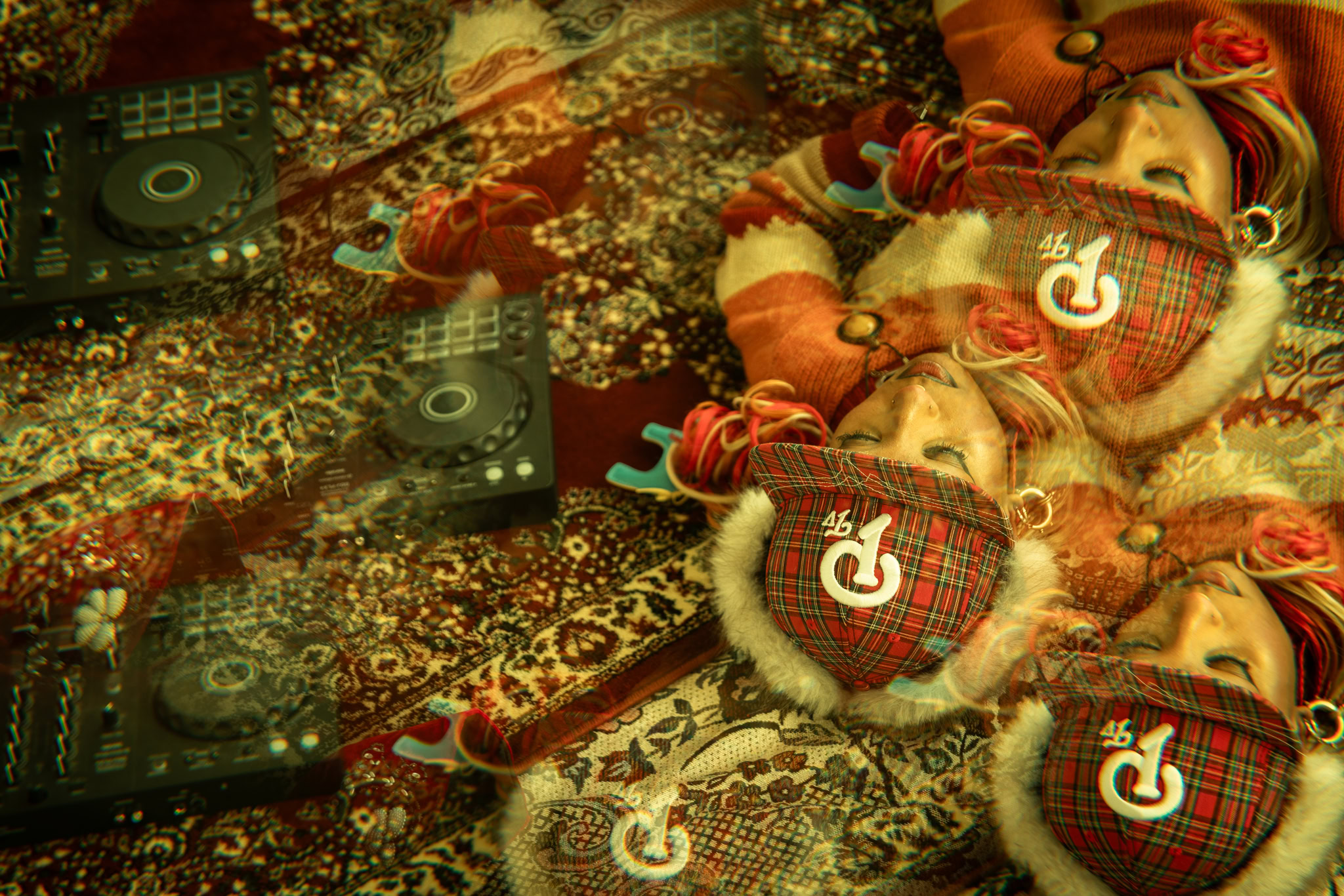
The Queer Migrations Artist Book launches on 26th September at the Poplar Union, East London, as part of Bold Mud, a boundary-bending live art and music event with Bold Mellon Collective and Mud Summons Records. The event starts at 7pm.
For more information and tickets, visit: https://www.boldmelloncollective.com/bold-mud