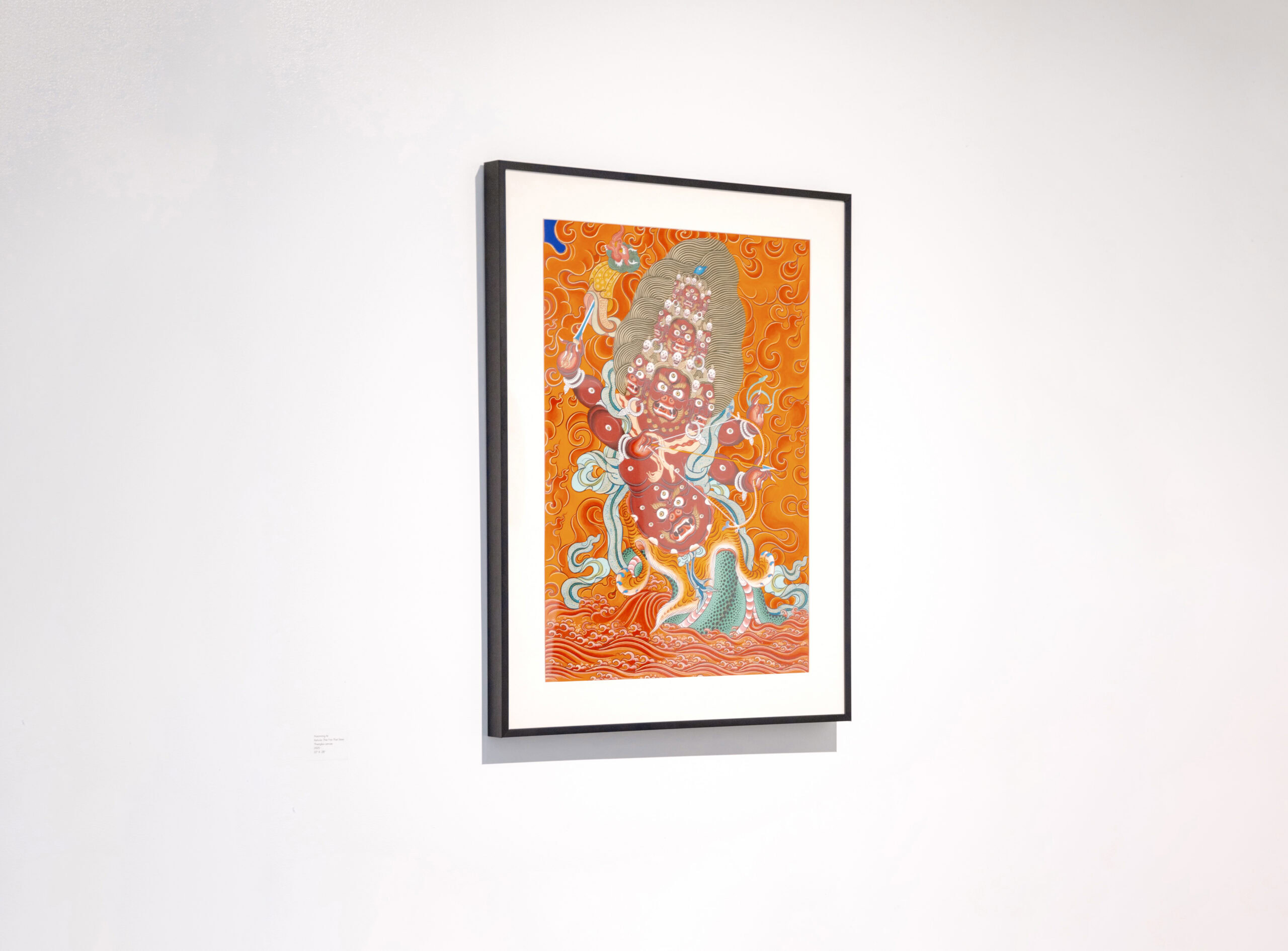
Skill, devotion, and ritual vitality are central in Xiaoming Ai’s Rahula: The Fire That Sees (2025), a work which – through its eerie visual field of green gradations and earthy tones, scarlet-orange flames, winding curves of molten gold, and feline and serpentine motions – embodies both aesthetic form and holy presence. In this work, Ai brings the traditional practice of Thangka into contemporaneity through her deep knowledge of sacred measurements and proportions. At the same time, she operates as an ethical artist, driven by discipline and spiritual purpose, in order tooffer the viewer a transcendental experience and to disseminate a distant cultural identity.

Ai’s work seeks to transmit the Vajrayana Buddhist notion of liberation through vision, in which gazing upon a consecrated image facilitates a movement towards spiritual and moral enlightenment. Through Thangka principles of embodiment, agency, and ceremonial activity, she also connects ancient notions of art as a moral and devotional act with the current decolonial impulse that challenges the framing of artistic production from the margins as mere craft. In doing so, Ai’s oeuvre not only actively contributes to intercultural exchange, but also partakes in ongoing debates about what constitutes ‘contemporary art’ within a global context, functioning as a mediating force between the East and the West. Through Rahula: The Fire That Sees, she places the viewer on a pathway of alternative epistemologies – one that, when entered on consciously, may allow us to leave behind the chaos, uncertainties, and unrest that characterise the Western world order.

Ai stages a dialogue between disparate ontologies through her engagement with technology and programming. In contrast to the globally integrated, financialised neoliberal logic, Rahula is woven from fire, his contours coil and unfurl from darkness, and his presence is not passive but dynamic intelligence in perennial motion. By juxtaposing Buddhist and technological worldviews, Ai makes us aware that whilst Rahula is a fierce guardian who reveals and transforms, the turbulent blaze of progress is inherently destructive. Moreover, her practice enables the drawing of parallels between Rahula’s multi-ocular anatomy and algorithmic surveillance architectures, highlighting that, although both resonate with the Foucauldian panopticon, the former dissolves ignorance and redeems its subjects, whereas the latter converts perception into control. Rahula’s multi-faced, multi-eyed form can be read as a metaphor for algorithmically governed systems, yet he does not extract value through regimes of total visibility from those who gaze upon him. On the contrary, Rahula’s vision, as Ai seems to suggest, operates as a protective portal that purifies and liberates beings from delusion.
As she bridges spiritual and technological regimes of vision, Ai draws attention to the fact that today’s data-driven governance and extraction operate through infrastructures that render human behaviour and psychological profiles into legible, measurable, optimisable, and monetisable information. In this context, it becomes clear that whilst tradition treats the principle of visibility as a pathway to insight, progress in contemporary systems turns it into an instrument of power.
Written by Kalinca Costa Söderlund