



Under the sun-drenched glass canopy of the restored Grand Palais, Art Basel Paris returned with an energy that felt electric – and slightly unexpected. The exhibition, which took place from October 24 to 26, welcomed a record number of visitors, over 73,000. In a time marked by political, social, and environmental unease, the fair revealed how artists are absorbing, resisting, and making sense of this moment.

This year’s event was a study of contrasts. Iconic figures – including Pablo Picasso, Agnes Martin, and Peter Paul Rubens – appeared alongside emerging artists from across the globe. With more than 200 exhibitors representing 41 countries, the fair’s scope was both dizzying and deliberate. Its three curated sections (Galeries, Emergence, and Premise) offered a snapshot of the art market’s present tense. Notably, 29 galleries were newcomers, a figure that the fair’s director, Clément Delépine, called “quite a statement”, given the fierce competition for space.
Amid the event’s multi-million-euro sales and across the aisles, bold voices of the new generation of artists managed to hold their own. Here’s our selection of ten artists who are redefining what contemporary art looks like and what it can offer audiences today.
Nikita Kadan
Born in Kiev, Nikita Kadan (b.1982) has long explored the social and political legacies of post-communist Ukraine, tracing historical connections between the Soviet past and the capitalist present. A major figure in the Ukrainian art scene, Kadan emerged as a resistance artist following the Russian invasion in February 2022, using his work to document, critique, and bear witness to the conflict.
Kadan works across installation, painting, wall drawings, posters, and graphic design, often collaborating with architects, human rights activists, and sociologists. A member of the artist group R.E.P. (Revolutionary Experimental Space) since 2004 and co-founder of HUDRADA, his practice blends activism and artistry, making him a vital voice for understanding contemporary Ukraine through both historical and immediate lenses. Voloshyn Gallery and Galerie Poggi presented a solo show by Kadan at Art Basel Paris.


Brisa Noronha
Brazilian artist Brisa Noronha (b. 1990) practices across drawing, painting, ceramics, video, and porcelain, investigating the “agency of matter” in the creative process. Her practice begins with the material itself – or a proposition to transform it. “Sometimes I start with the material itself. Sometimes I start with a subject or proposition to be developed, and the material asserts its importance in the process, or even becomes the subject”, the artist explains. In many of her works, porcelain and brass wire work together to form large, sculptural hybrids that blur craft and concept.
In Paris, Noronha’s Mini Mundos (Mini Worlds) display was one of delicate resilience, featuring a porcelain sculpture that felt both fragile and powerful. The artist frequently works with porcelain, a material that carries the appearance of fragility but, in actuality, is remarkably strong. Noronha was presented by Gallery Luisa Strina.


Hayfa Algwaiz
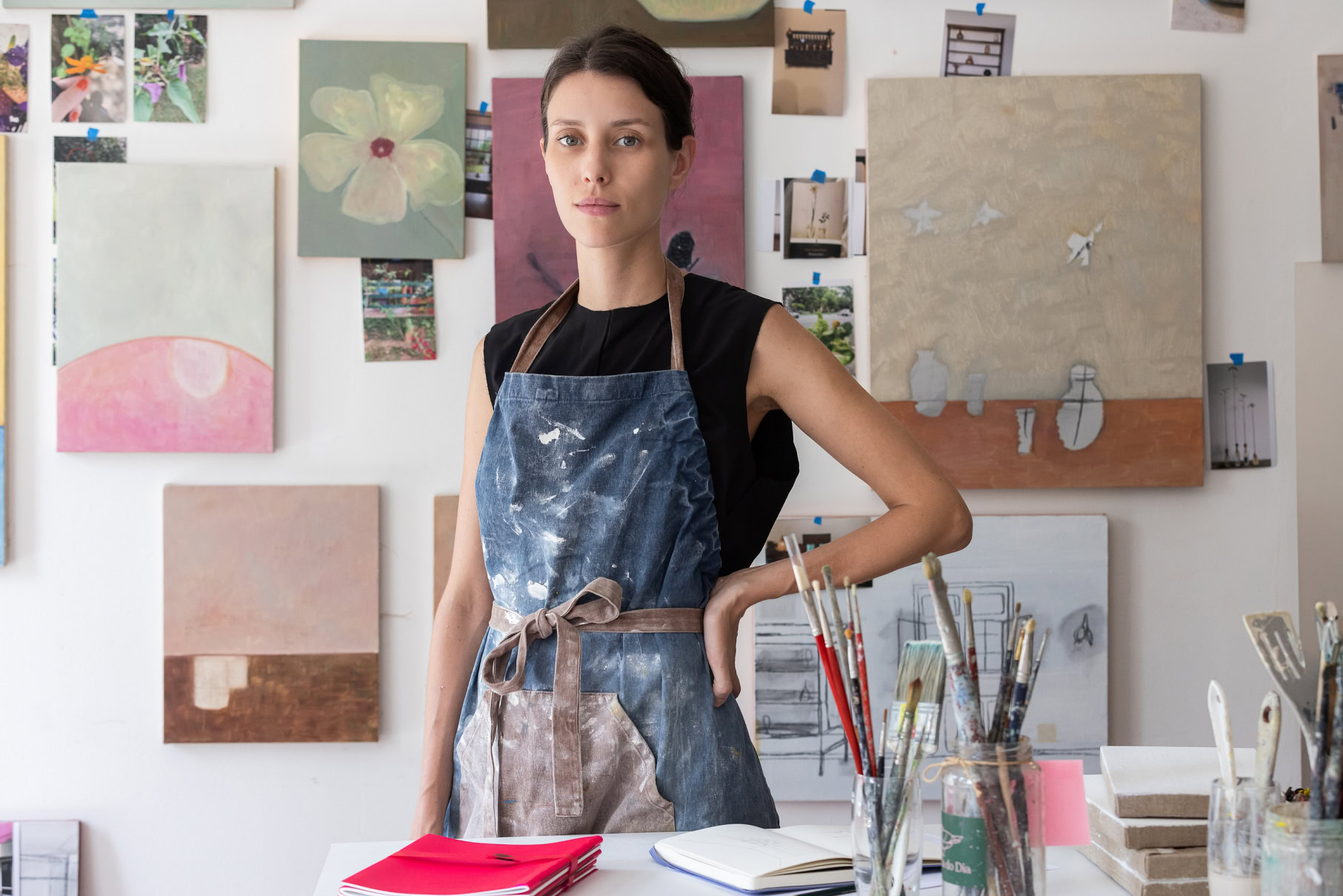
Hayfa Algwaiz (b. 1991) is a Saudi architect-turned-artist whose work explores memory, absence, and the perception of place. Drawing, painting, and spatial studies allow her to reveal what is often overlooked, focusing on removal, redaction, and partial visibility. Her architectural background is evident in the precision of her compositions, capturing the duality between interior and exterior spaces, and recording the shifts and memories within home and city.
Algwaiz examines the interplay of interior and exterior worlds: domestic scenes reflect culture, family, and tradition, while exterior landscapes speak to progress, modernisation, and collective identity. Employing techniques such as axonometric projection, rendering, and realism, she transforms ordinary rituals and habits into visual studies of how personal and collective identities are shaped. Beneath her calm precision, Algwaiz’s work occasionally nods to darker, unsettling motifs – gestures toward corporeality and vulnerability, like in her painting, A Woman’s Body, which depicts a female bust-shaped meat carcass and was showcased in Paris, where Algwaiz was represented by ATHR Gallery.


Elene Chantladze
Elene Chantladze (b. 1946) lives and works in Tskaltubo, Georgia. Her practice represents what she calls “free drawing”, capturing the impromptu process of painting in the moment. Chantladze frequently works on found or everyday surfaces, including stones, cardboard, and the backs of cupboards. She mixes colored pencils, gouache, ballpoint, coffee, pressed fruit juice, and grease to generate abstract grounds that guide her compositions. From these layers, faces, figures, animals, and landscapes emerge, blending figuration and abstraction in dense, theatrical spaces.

Chantladze’s subjects arise from her immediate surroundings: village life, family, folklore, and the social and political histories of Georgia. Female figures often emerge, at times in tender or intimate scenarios, at others in isolation or introspection. Echoing Surrealist automatism and Eastern Orthodox iconography, her compositions balance spontaneity and observation, making her first institutional solo exhibition at Kunsthalle Zürich a long-awaited recognition of her deeply personal yet socially attuned vision. She was presented by LC Queisser.

Karol Palczak
Polish artist Karol Palczak (b. 1988) blends painting, moving image, and folk ritual to capture the quiet tensions of Krzywcza, his native Subcarpathian town. Drawing from historic traditions of painting as well as vernacular filmmaking practices, he transforms mountains, valleys, and the banks of the San River – a political and cultural border between Poland and Ukraine – into lifelike, almost photorealistic portraits that reveal both the beauty and the fragility of human and natural life in the region. At this year’s fair, Palczack’s still life of eels (a fish indigenous to the San), painted on marble, embodied his signature blend of realism and reverence to the overlooked.
For over a decade, Palczak has keenly observed his environment, painting the complicated and at times violent history behind his surroundings. His videos, by contrast, are chaotic and improvisational: the camera shakes, frames tilt, fires burn, friends flee. Across media, his work considers memory, modernity, and collective anxieties, recasting his subjects as intimate sites of spiritual survival. Palczak was represented by Foksal Gallery Foundation at Art Basel Paris.


Mira Mann
German artist Mira Mann (b. 1993) works across time-based, site-specific, and cross-media projects, exploring fictional spaces and storytelling to visualise social structures, collective memory, and emerging narratives of identity. Presented in the fair’s “Emergence” sector, Mann’s objects of the wind (2024) revealed itself to be far more than a mise-en-scène: a densely arranged dressing room environment of mirrors, lightbulbs, drums, books, photographs, and glass spires that layered myth, memory, and migration. The inspiration to use dressing room mirrors in her exhibition came from a desire “to see parts that are usually hidden”.
Rooted in archival research and oral histories, Mann’s installation pays tribute to the Korean contract nurses who migrated to West Germany between 1966 and 1973. By foregrounding the objects that shaped their collective life, the artist reinterprets pungmul, the traditional Korean practice of drumming, dancing, and singing, as an act of care, protest, and belonging. Mann’s work was showcased by DREI Gallery.


Evelyn Taocheng Wang
Evelyn T. Wang (b. 1981), born in China and now based in Rotterdam, works across painting, drawing, installation, video, and sculpture. Wang studied art, literature, and graphic design at Nanjing Normal University before completing postgraduate work at Frankfurt’s Städelschule and De Ateliers in Amsterdam. Her work emerges from her interest in authenticity and how we go about performing it, weaving together personal and collective histories with references to art history, literature, and everyday life.
Wang often draws on her experiences of immigration and belonging, reflecting on gender, class, and style. She approaches serious themes with a sense of humour and irony, rather than confrontation or direct critique. Some of her work incorporates garments and textiles, highlighting how appearance and material culture shape perception. She cites Agnes Martin (whose work was also present at Art Basel Paris) as a key inspiration. According to Wang, “Her work reminds me that a painting can be created with different layers and illuminate each of them”. In Paris, she was presented by Carlos∕Ishikawa.


Nolan Simon
American painter Nolan Simon (b. 1980) lives and works in Detroit, Michigan. His photorealistic paintings focus on fragments of the body – hands, feet, torsos – or everyday objects, rather than full figures, exploring the liminal spaces of image, surface, and meaning. Layered canvases reinterpret traditional techniques through modern methods such as dye sublimation and printed under-layers, reflecting the saturation of today’s image economy.
His work considers how the ubiquity of digital images has reshaped perception and attention, questioning what remains singular or intimate in a world dominated by screens. At the Paris fair, his paintings felt especially timely, offering both formal rigour and subtle philosophical critique – a reminder of how emerging voices can contribute to, and subtly subvert, the contemporary art ecosystem. Simon’s work was showcased by 47 Canal.


Alicja Kwade
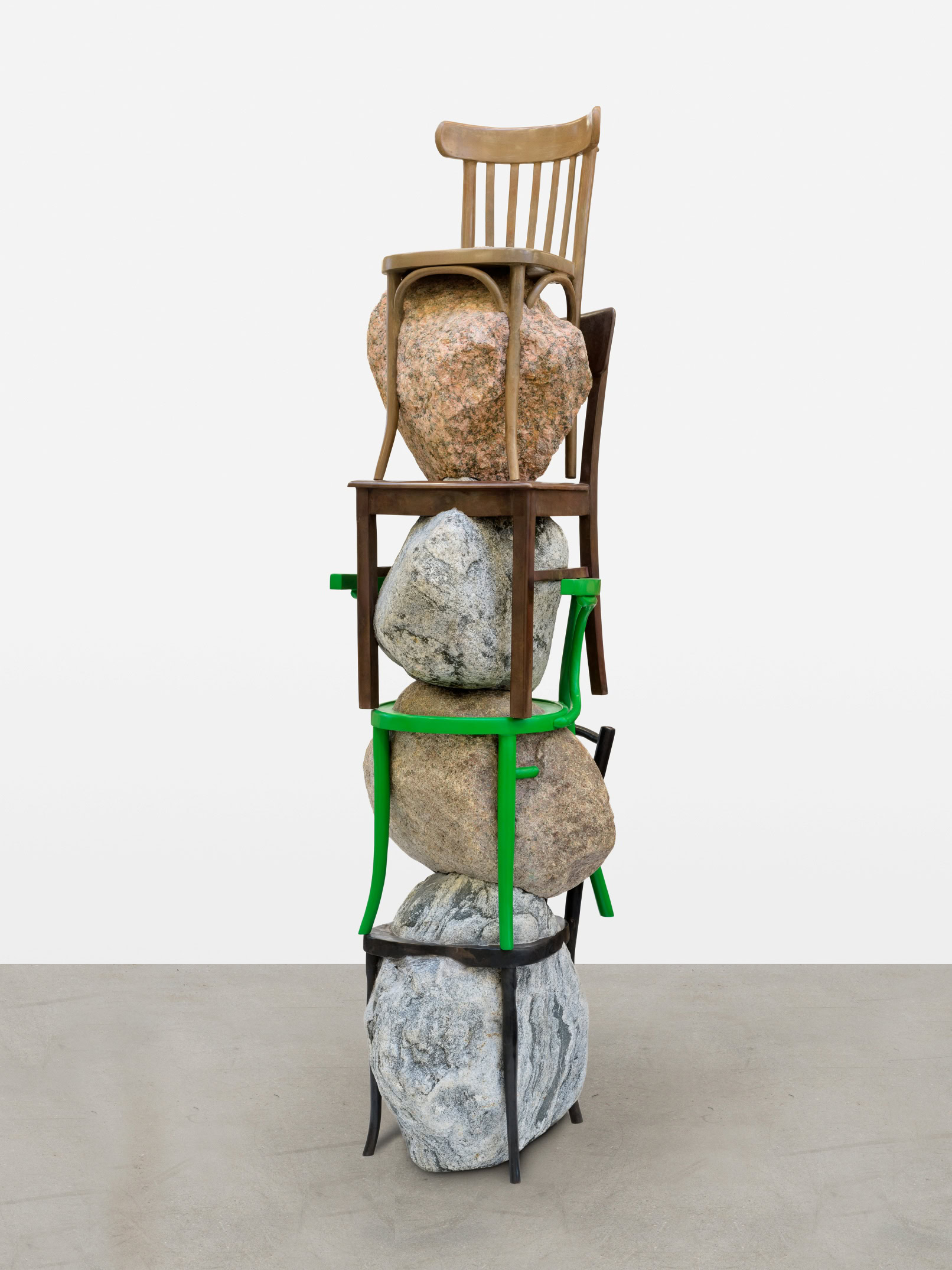
Alicja Kwade (b. 1979) remains a pivotal artist for her use of minimalism, material and perception to question the world. Born in Katowice, Poland, she builds elegant, disorienting systems that ask how we construct (and believe in) our own version of reality. Working across sculpture, installation, video, and photography, Kwade draws on philosophy, physics, and cosmology to probe the fragile frameworks that govern perception, time, and matter.
Her art, often described as both conceptual and sensual, uses industrial precision to stage metaphysical questions. Her sculptures extend beyond gallery spaces, taking on monumental scale in public and outdoor settings, from Central Park (Against the Run, 2015-16) to museum gardens worldwide. Kwade’s strength lies in her ability to make thought visible—bridging intuition and intellect, matter and idea. At Art Basel Paris, where she was represented by 303 Gallery, her presence reaffirmed how deeply contemporary sculpture can think without ever failing to feel.


Cornelia Baltes
Berlin‑based painter (b. 1978) Cornelia Baltes merges figuration and abstraction with gestural line, vibrant colour and quiet narrative. Baltes’ work oscillates between abstraction and figuration, reducing corporeal motifs – faces, hands, feet – and everyday observations, like clothing or expressions, to sloping lines that balance subtle humour with intensity. She challenges the notion of painting as a discrete object, extending works beyond the canvas: murals, shaped canvases, pieces on casters, and paintings that spill onto walls.
Charged with a sense of movement and open narrative, Baltes’ paintings invite viewers to project personal memories and associations, transforming each work into a shifting site of interpretation. Her installations extend painting into space, challenging its frame and inviting a physical encounter with colour and form. Baltes presented a major solo exhibition at Fuhrwerkswaage in Cologne in spring 2025, while in Paris, she was represented by Andréhn-Schiptjenko Gallery.