


There is a danger in arriving too soon with a diagnosis, just as there is a danger in arriving too late. The first transforms complexity into a symptom before understanding the systems that produced it; the second produces an archive only after the wound has already reorganised reality. Between these two failures, the 61st Venice Biennale, In Minor Keys, proposes another temporal position — one that does not search for the authority of the final statement, but for the possibility of remaining with hesitation, friction and unresolved forms of knowledge.
This edition unfolds under exceptional circumstances. The Cameroonian-Swiss curator Koyo Kouoh, appointed artistic director of the Biennale, died before the realisation of the exhibition, leaving behind not only a curatorial structure but also an unfinished reflection on attention, resonance and the politics of quieter frequencies. The continuation of the project after her death transforms absence into more than a biographical event; it becomes strangely connected to the very logic of the exhibition itself.
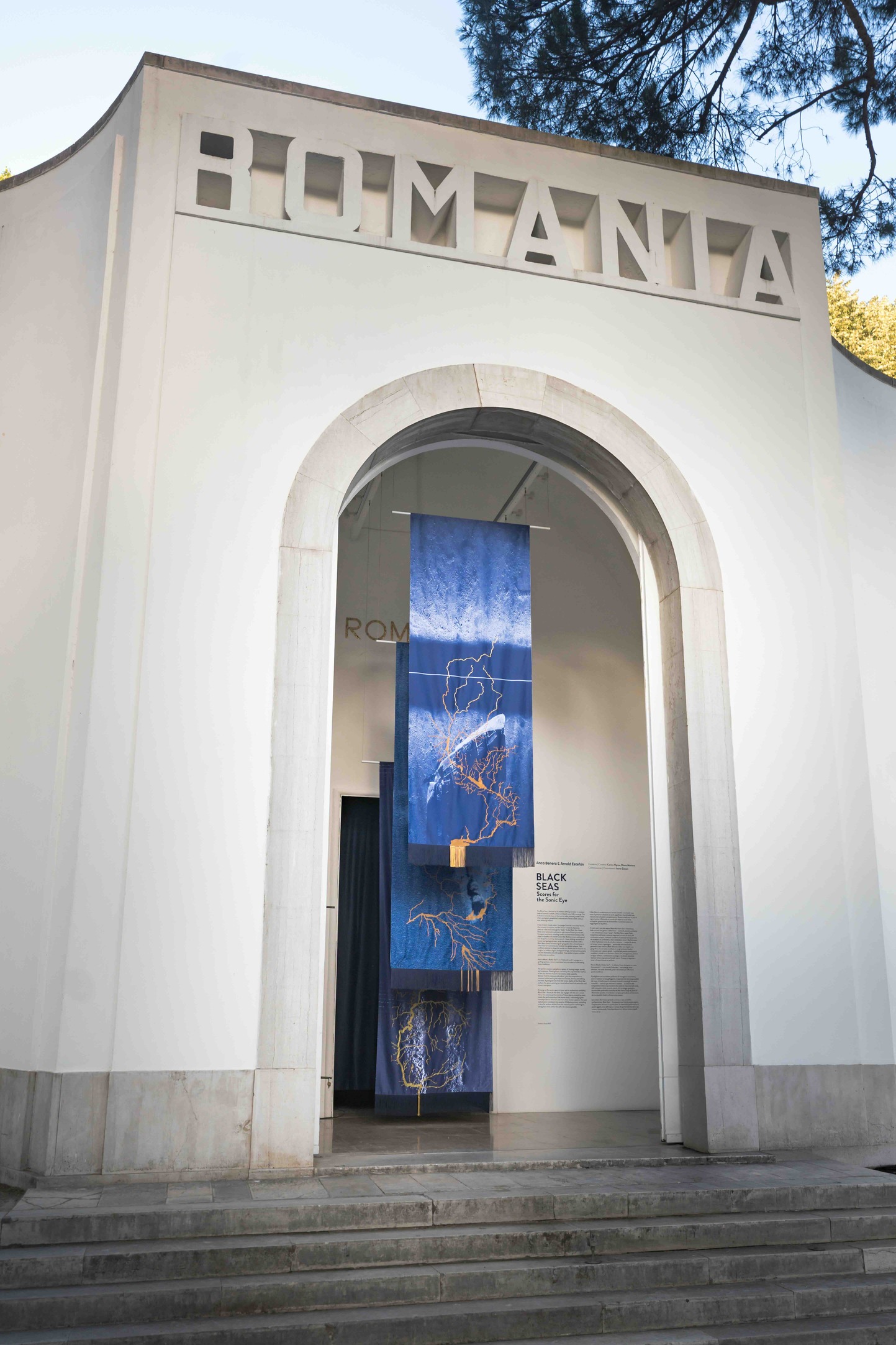
In Minor Keys is carried through echoes, relations and continuities rather than through the authority of a single voice. Within this framework, Black Seas – Scores for the Sonic Eye, presented at the Romanian Pavilion by Anca Benera and Arnold Estefán and curated by Corina Oprea and Diana Marincu, examines ecological crises and how they become perceptible, inviting us to rethink the ways we see, listen to, and relate to the environments we inhabit.

The Sea as Archive
At a moment shaped by ecological instability, wars, accelerated information cycles and the return of aggressive national imaginaries, contemporary art finds itself caught inside a difficult expectation: it must respond immediately, clarify its position and transform complexity into visible ethical statements. Yet this constant demand for readability risks producing its own exhaustion, where even resistance becomes formatted and political urgency becomes another recognisable cultural language. Perhaps the question today is no longer only what art can reveal, but what forms of attention it can still protect.

The Venice Biennale has always operated within this contradiction. It remains a powerful machine of visibility, but also one of the places where the mechanisms of visibility can be questioned. The national pavilion system itself belongs to an older political imagination, where nations occupy architectural spaces and transform themselves into exhibitions. Yet many of the most urgent realities of the present — climate change, migration, militarisation, technological infrastructures and resource extraction — no longer respect the borders through which these structures define the world.
Perhaps the question today is no longer only what art can reveal, but what forms of attention it can still protect.
The form remains, but the conditions have changed. This is where the movement from performance toward transformance becomes important. Performance executes an existing structure; transformance works from inside that structure and changes what it is capable of containing. Against this larger context, Anca Benera and Arnold Estefán’s Black Seas – Scores for the Sonic Eye, does not approach ecological crisis through the familiar language of catastrophe. Instead of producing another image of damage, the exhibition investigates the conditions through which damage becomes perceptible.

Working together since 2012, Anca Benera and Arnold Estefán have developed a practice that moves across multimedia installation, sculpture and drawing, investigating the fragile intersections between history, environment and resource politics. Their research often begins with the invisible forces that shape territories — from military infrastructures and extraction economies to ecological transformations — questioning how past conflicts continue to alter the landscapes, climates and communities of the present. Rather than approaching nature as a separate field from human history, their work examines environments as contested archives where political decisions, geological processes and technological systems continuously overlap.
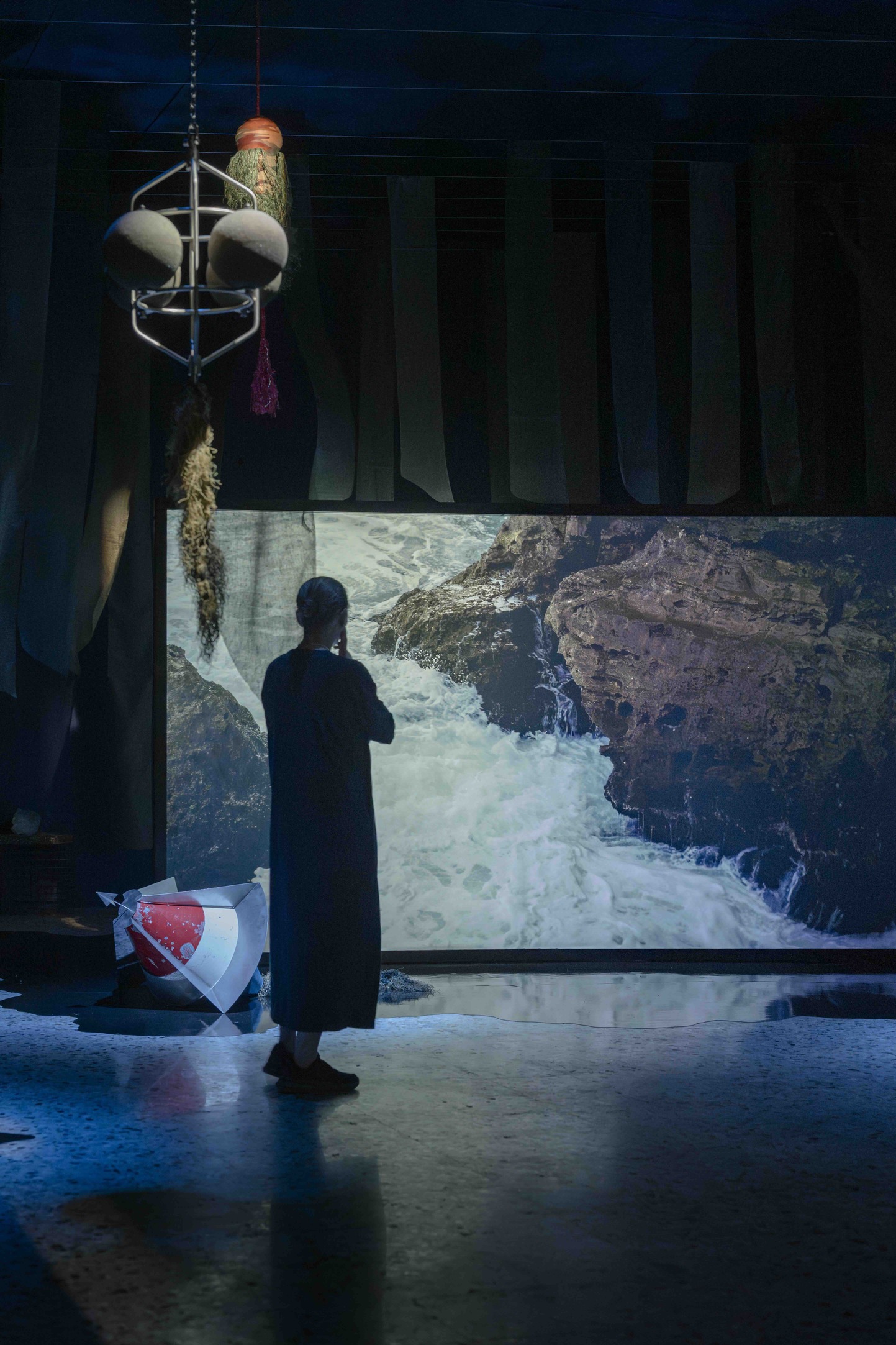
This long-term investigation finds a precise continuation in Black Seas – Scores for the Sonic Eye, where the sea is treated not as a landscape to be represented, nor as a symbolic territory attached to national identity, but becomes a complex system where ecological processes, military histories, geological transformations and economic infrastructures continuously interfere with each other. The sea appears as a form of memory without monumentality — an archive that does not preserve through documents, but through sediments, currents, chemical changes, technological remains and material traces.
Rather than approaching nature as a separate field from human history, their work examines environments as contested archives where political decisions, geological processes and technological systems continuously overlap.
Listening, Perception and the Sonic Eye
The title itself introduces the perceptual displacement around which the project unfolds. The “sonic eye” suggests a hybrid organ that questions the historical privilege given to vision as the dominant form of knowledge. To see has often meant to create distance: the observer separates themselves from what is observed, transforming the world into something that can be mapped, measured and eventually controlled. Sound proposes another relationship because it travels through matter and environments, transforming perception into contact rather than possession. This shift becomes particularly charged considering the histories embedded in underwater listening technologies. Sonar developed from military needs — the desire to navigate, detect and control spaces inaccessible to human sight. The opacity of the ocean was treated as a problem requiring technological correction. What could not be seen had to become information.

Benera and Estefán remain inside this contradiction. They do not imagine technology as innocent, but neither do they simply reject it. Instead, they expose how the same instruments capable of producing knowledge about fragile ecosystems are connected to histories of surveillance, militarisation and extraction. This complexity prevents Black Seas from becoming a nostalgic ecological project based on the fantasy of returning to an untouched nature. The sea is approached as a space where histories have always accumulated: geological processes, biological transformations, economic interests and political conflicts are already part of its material condition.
Instead of preservation and stability, Benera and Estefán propose an archive that is unstable and constantly rewritten. The Black Sea does not preserve events as finished memories, but carries their consequences.
The sea is not outside history; it is one of the places where history continues to happen. The notion of archive is therefore transformed. Instead of preservation and stability, Benera and Estefán propose an archive that is unstable and constantly rewritten. The Black Sea does not preserve events as finished memories, but carries their consequences.

Geographies of Extraction
This understanding connects with Johannes Fabian’s critique in Time and the Other. Fabian showed how systems of knowledge often create distance from the Other by placing it in another temporality — as something delayed, primitive or outside the present. A similar mechanism structures humanity’s relationship with the non-human world, which has frequently been imagined as slower, passive and disconnected from modern time. Black Seas challenges this separation. Geological and oceanic processes are not remnants of another world; they are active participants in the present. The depth of the sea is not a return to the past, but another layer of contemporaneity where underwater cables, military technologies, extraction industries and ecological mutations coexist.

The difficulty is that human systems organise reality around events, while many of the transformations shaping the planet happen gradually, beneath immediate perception. This problem becomes central in Benera and Estefán’s investigation of extraction. Contemporary expansion no longer functions only through the occupation of visible territories. Increasingly, it moves vertically — into geological layers, seabeds and hidden infrastructures. The ocean floor, once imagined as unreachable, has become one of the newest spaces of economic interest.

Their work Blue Ground expands this geography by connecting the Atlantic Ocean, the Namib Desert and the Black Sea shipyard involved in the construction of the diamond-mining vessel Benguela Gem. Extraction appears not as a localised action, but as a planetary choreography involving distant territories, technologies, economies and forms of labour. A ship produced in one geography participates in transformations occurring elsewhere; an extracted mineral contains networks that exceed any single location.
Every system produces its own blind spots, and every form of observation creates new invisibilities. The “sonic eye” therefore becomes not only a tool for discovering hidden realities, but also a reflection on the limits of discovery itself.
Niklas Luhmann’s systems theory offers another way of understanding this complexity. Ecological crises are not simply produced because humans act upon nature as an external object, but because different systems — economic, technological, scientific and political — interact while remaining partially unable to observe the consequences of their own operations. Every system produces its own blind spots, and every form of observation creates new invisibilities. The “sonic eye” therefore becomes not only a tool for discovering hidden realities, but also a reflection on the limits of discovery itself.

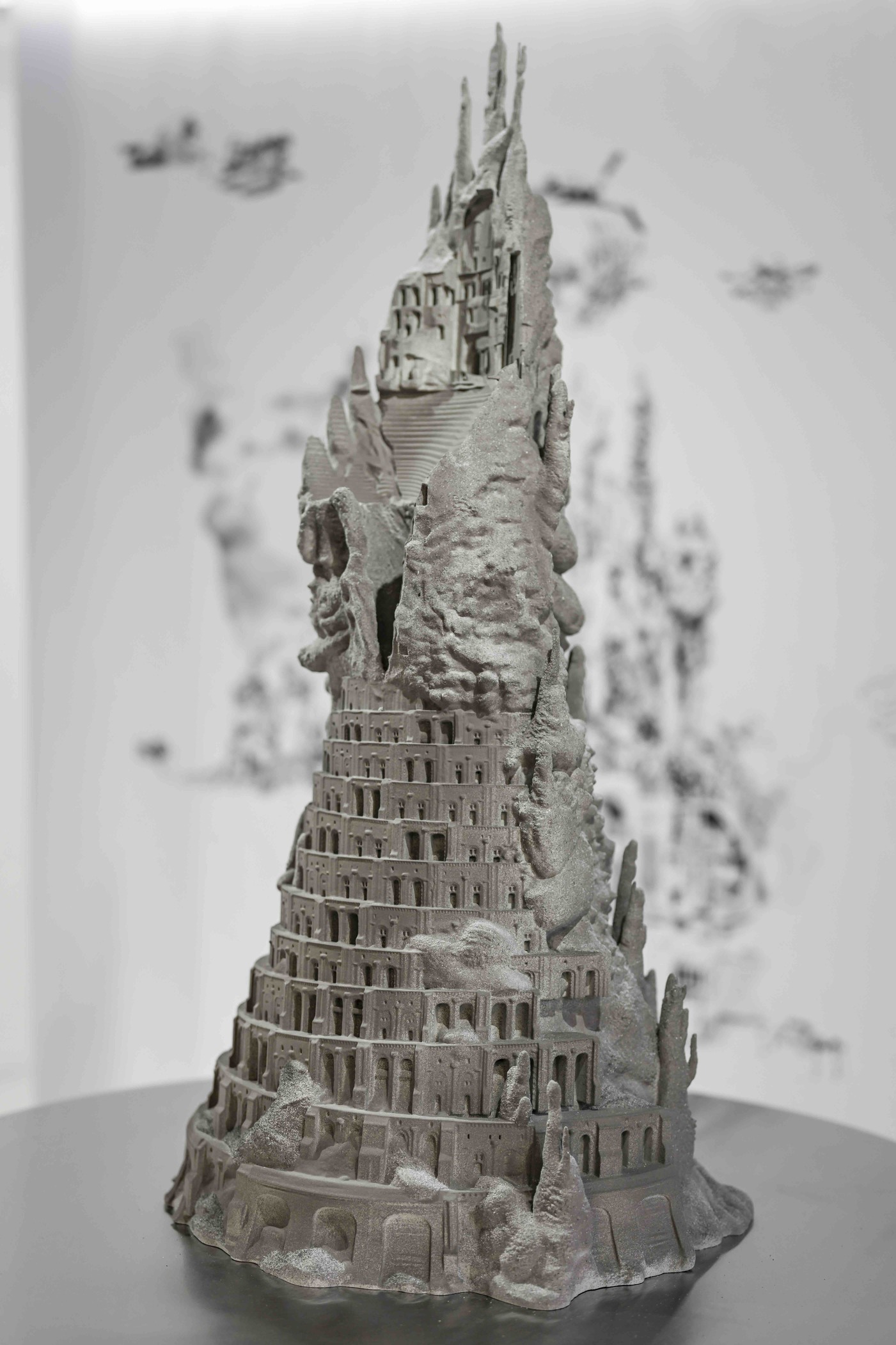
This question continues through The Delusion of the Commons, where Benera and Estefán connect the deep-sea hydrothermal vent with the mythological construction of the Tower of Babel. One belongs to planetary origins, to environments where life emerges independently from human intervention; the other represents the human fantasy of unlimited construction and expansion. Between them appears one of the fundamental contradictions of modernity: the belief that what is defined as “common” automatically escapes possession.
Learning to Listen Differently
The deep sea destabilises the categories through which societies understand ownership. Political systems depend on visibility: territories are mapped, borders are drawn, and resources are measured. Yet oceanic environments exist through movement, depth and relations that cannot easily become property.
This tension returns directly to Venice’s pavilion system. A national pavilion is built on distinction, but Benera and Estefán introduce a subject that exceeds national logic. The Black Sea can enter the Romanian Pavilion only by demonstrating the impossibility of containing it within Romania. The sea becomes an unstable representative. It belongs simultaneously to multiple territories, histories and political conflicts, but even these descriptions remain insufficient. Currents, sediments and ecological processes reveal forms of continuity that precede and exceed borders.

This is particularly relevant today, when the Black Sea is marked by war, militarisation, energy infrastructures and competing geopolitical claims. Yet the artists avoid transforming conflict into spectacle. They are interested less in the visible moment of crisis than in what remains afterwards — the residues and transformations through which violence continues to operate. Consequences survive longer than events.
This is where the project enters the logic of In Minor Keys. The minor is not simply the forgotten voice waiting to become dominant. The goal is not to make everything louder, but to question whether volume was ever the correct measure of importance. In a culture overwhelmed by information, visibility itself has become unstable. Images of destruction circulate continuously, yet visibility alone does not guarantee transformation. The problem is not only that certain realities remain hidden; it is that what is visible often loses its capacity to affect us. This could be understood as a decay of data: the moment when information multiplies while attention decreases.

Against this condition, Black Seas – Scores for the Sonic Eye does not propose more information, but another form of proximity. Listening becomes a way of resisting accelerated consumption because listening requires duration, exposure and the willingness to be affected by something that does not immediately become clear. Perhaps this is the deeper connection between the Romanian Pavilion and Koyo Kouoh’s unfinished vision for In Minor Keys. Both suggest that the future of critical practice may depend less on producing stronger statements and more on developing different capacities of attention.
The final proposition of Benera and Estefán’s project is not that the sea contains a hidden message waiting to be decoded. That would repeat the old fantasy that the world exists as a mystery waiting for human intelligence to solve it. Instead, the exhibition suggests something more demanding: that the world has always been producing signals, relations and forms of memory outside our systems of recognition. The question is not whether the depths can finally speak. They were never silent. The question is whether we are capable of changing ourselves enough to listen.
Listening becomes a way of resisting accelerated consumption because listening requires duration, exposure and the willingness to be affected by something that does not immediately become clear.